
The Complete Guide to Electrical Panel Upgrades in Utah
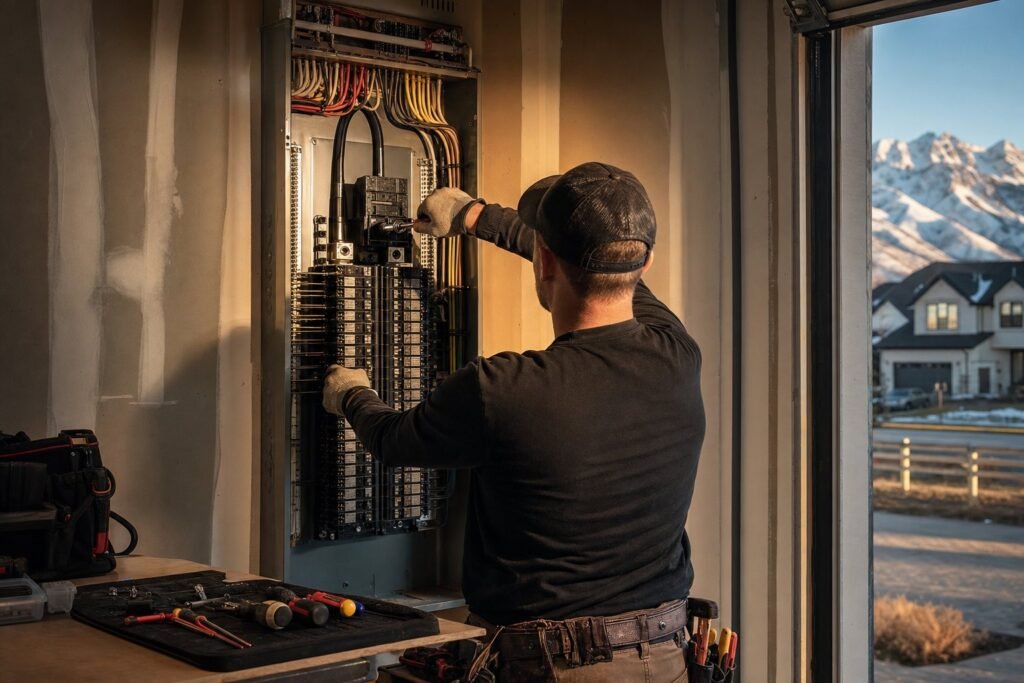
Your electrical panel decides how much of modern life your house can run at once, and along the Wasatch Front a large share of the housing stock is still working with equipment sized for a different century. This guide walks the whole decision: how to tell a panel is full, what 200-amp service buys you, which brands to replace on sight, real Utah pricing of $1,500–$3,000 for a typical 100-to-200-amp change, the permit and Rocky Mountain Power steps, and exactly what happens on install day.
In this guide
- When does a panel actually need upgrading?
- How can you tell your panel is full?
- What is a double-tapped breaker?
- Should you go to 200 amps?
- Which old panel brands get replaced on sight?
- How do AFCI and GFCI rules change the job?
- What about the meter base and mast?
- What does a panel upgrade cost in Utah?
- Who handles permits and Rocky Mountain Power?
- What happens on install day, start to finish?
- Why is this the one job you never DIY?
- When is a subpanel, or nothing, the smarter buy?
- Quick answers
When does a panel actually need upgrading?
A panel earns replacement for one of two reasons: it can’t carry what your household now demands, or the equipment itself has become a liability regardless of load. Both problems are common here because the Wasatch Front was built in waves. Pre-war homes in Ogden’s Avenues often started with 60-amp fuse service. The post-war bench neighborhoods went up with 60 to 100 amps and gas everything. The 1970s brought aluminum branch wiring into some subdivisions, and even 1990s construction frequently got the builder-minimum panel with zero spare thinking.
Meanwhile the demand curve only climbed. Central air became standard, kitchens went induction, garages started charging cars, and basements got finished into apartments. A panel sized in 1968 was never asked to referee that fight. If yours is losing it, you’ll usually see warnings first; our rundown of the nine signs a panel is overloaded or obsolete covers the symptom side in detail, and why breakers keep tripping explains the most common one.
Condition failures deserve their own mention, because they ignore the load math entirely. Bus bars corrode where moisture has visited, breaker springs fatigue after decades of thermal cycling, and lugs loosen as seasons expand and contract the metal. A panel can be perfectly sized for your loads and still be twenty years past trustworthy. Capacity questions get answered with arithmetic; condition questions get answered with eyes and a screwdriver, which is why a proper evaluation includes both.
There’s also a planning trigger that has nothing to do with symptoms: any single big addition. A Level 2 charger from our home EV charger guide, a standby unit from the Utah generator guide, a hot tub, or a heat pump conversion each starts with the same question: does the service have room?
How can you tell your panel is full?
“Full” means two different things, and homeowners usually only check one. Slot-full is visual: every breaker position is occupied, so a new circuit has nowhere to land. Capacity-full is mathematical: the connected loads, run through the load calculation the code requires, leave no legal room on the service even if empty slots exist. A panel can be either, both, or neither, and the fix differs for each.
The quick self-check: open only the outer door. Count open positions. Look for skinny side-by-side breakers sharing one slot (tandems), which usually mean somebody already ran out of space once. Then look at the main breaker rating and mentally stack your 240-volt loads against it: air conditioner, dryer, range, water heater if electric. Three or four big loads against a 100-amp main is a crowd.
A note on tandems while you’re looking: they aren’t automatically wrong. Panels list on their labels which positions, if any, accept tandem breakers, and installations that respect the label are legal. The trouble starts when tandems appear in positions the label forbids, or when they’ve multiplied until the circuit count far exceeds what the panel was designed to organize. At that point the panel is telling you its story: demand kept growing and nobody wanted to face the service question.
A panel with empty slots can still be out of capacity, and a packed panel can still have amps to spare.
The definitive answer is a load calculation, which is arithmetic a licensed electrician does from your actual square footage and appliance list, not a guess from the driveway. It takes minutes during an evaluation and it settles the real question: more service, more slots, or neither.
What is a double-tapped breaker?
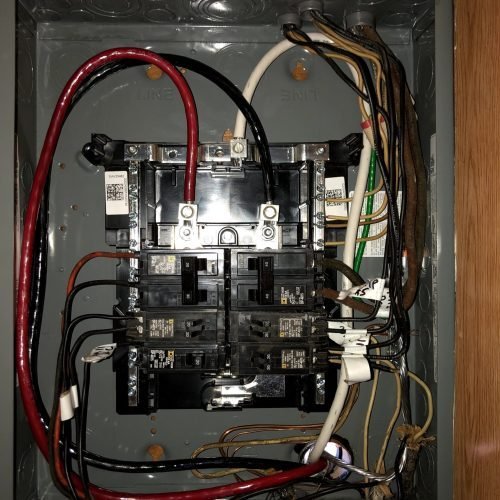
A double-tap is two circuit wires landed under a single breaker’s lug. Home inspectors call it out constantly because it’s the classic signature of a panel that ran out of room: rather than add capacity, someone doubled up. Most breakers are designed to clamp exactly one conductor, so the second wire sits loose in a connection that was never shaped for it. Loose connections arc, arcing makes heat, and heat inside a panel is the failure mode you least want.
A small number of breaker designs are actually listed for two conductors, so not every double-tap an inspector photographs is a violation. But even a legal one is a symptom worth reading: the panel had more circuits than positions. The repair menu runs from cheap to structural: pigtail the two wires to a single lead, swap in a listed tandem breaker where the panel allows it, add a subpanel, or, if the double-taps are one symptom among several, replace the panel and stop treating symptoms.
Should you go to 200 amps?
For most upgrades the answer is yes, because you’re paying for labor, permit, and utility coordination either way, and the incremental cost of the larger equipment is small next to doing the whole exercise twice. Two hundred amps is the new-construction default for a reason: it absorbs an EV, a spa, and an electrified kitchen without another service change for decades.
| Question to ask | Points toward keeping 100A | Points toward 200A |
|---|---|---|
| What fuels heat, water, cooking? | Gas across the board | Electric now, or electric planned |
| Any big loads coming? | Nothing on the five-year horizon | EV, hot tub, heat pump, or ADU in the plan |
| How does the load calc land? | Comfortable margin remains | At or near the ceiling already |
| Why are you touching the panel? | You aren’t; it’s healthy | Replacement is happening anyway |
The full comparison, including how to read your main breaker and what modern loads draw, lives in our deep dive on 100-amp versus 200-amp service. Treat this section as the summary and that post as the homework.
One capacity consumer people forget to count: backup power. Generator transfer equipment and battery systems both want space and, in some configurations, capacity in the panel they serve, so a household planning for canyon-wind outages has one more reason to size the service generously while the wall is already open. The same logic applies to whole-home surge protection, which modern code expects on service replacements and which installs cleanly in a new panel.
Which old panel brands get replaced on sight?
Two names dominate this conversation: Federal Pacific Electric (the Stab-Lok line) and Zinsco, both installed by the millions through the mid-century decades. Independent testing over the years has documented breakers from these lines failing to trip under fault conditions at troubling rates, which defeats the one job a breaker exists to do. Insurers and home inspectors treat them accordingly: many carriers surcharge, demand replacement, or decline the risk outright.
Identification, era, failure mechanics, and what replacement involves all get full treatment in our post on Zinsco and Federal Pacific panels. The short version for this guide: if either name is on your panel door, skip the load calculation debate. The equipment itself is the reason to replace, and the only real questions left are scheduling and scope.
How do AFCI and GFCI rules change the job?
Replacing a panel isn’t a like-for-like part swap, because the code that applies is the code in force today, not the code from the year your house was built. Utah adopts the National Electrical Code statewide with amendments, and the modern editions expect two protections your 1975 panel never heard of.
GFCI (ground-fault) protection guards people: it senses current leaking outside the intended path, the shock scenario, and is required in wet and damp territory such as kitchens, bathrooms, garages, and exteriors. AFCI (arc-fault) protection guards the structure: it recognizes the electrical signature of arcing in damaged cords or wiring and is required across most living-area circuits in current code.
The practical effect on your project: a chunk of the new panel gets populated with AFCI, GFCI, or dual-function breakers, which cost several times what plain breakers cost and account for a real slice of the price spread between quotes. It also means the upgraded panel genuinely protects better than the one it replaced, which is the point.
Straight answer on nuisance tripping: older appliances, especially motors and treadmills, occasionally annoy AFCI breakers. A good installer sorts listed workarounds and circuit choices with you instead of quietly leaving protection out. Ask about it up front rather than after the third trip.
What about the meter base and mast?
The panel is the indoor half of your service equipment. Outside sits the meter base (the enclosure the utility meter plugs into), the mast or riser that receives the overhead drop where service is overhead, and the service entrance conductors tying it all together. On a service upgrade, this outdoor chain has to match the new amperage: a 100-amp meter base cannot legally or safely feed a 200-amp panel.
That’s why quotes for the same house diverge. If your meter base is modern and correctly sized, it stays. If it’s undersized, rusted, or an obsolete style, it gets replaced in the same visit, along with mast repairs where canyon winds have worked the weatherhead loose over the years. Ownership matters here too: broadly, Rocky Mountain Power owns the wires up to the connection point and the homeowner owns the mast, meter base, and everything past it, so this equipment is your side of the fence even though the utility’s meter lives in it.
Overhead versus underground service also shapes the work. Overhead homes have the mast and weatherhead to inspect and sometimes rebuild, while underground services route through a lateral and different metering arrangements, each with its own coordination details when the amperage changes. Neither is better or worse for the project; they’re just different scopes, and the evaluation should name which one your quote is built around.
What does a panel upgrade cost in Utah?
The typical Utah market range for a straightforward 100-to-200-amp service upgrade runs $1,500–$3,000, covering the panel, breakers, permit, utility coordination, and a day of licensed labor. Where a specific house lands inside or above that band depends on the outdoor equipment, the wire, and the wall.
Upward pressure comes from a meter base or mast that must be replaced, a panel being relocated to a compliant spot, aluminum service conductors that need attention, and the code-required protective breakers described above. Downward pressure is rarer but real: healthy exterior equipment and an accessible, well-located panel keep a job near the bottom of the range. We’ve broken the whole equation out in what a panel upgrade costs in Utah, and our panel and meter upgrade service page explains how we quote it: evaluation first, written number second, work third.
One budgeting note that surprises people pleasantly: bundling matters. If the panel change is happening ahead of an EV circuit or hot tub feed, running that circuit while the panel is open costs meaningfully less than a separate visit and permit cycle later.
Who handles permits and Rocky Mountain Power?
A service change is permitted, inspected work in every Utah jurisdiction, and your contractor should be the one pulling the permit, because the entity on the permit is the entity accountable for the work. The city’s inspector then reviews the finished installation before the permit closes, which is your independent check that the job meets code.
The utility is the second coordination thread. Nobody can safely swap service equipment while it’s energized from the street, so the job is scheduled around a Rocky Mountain Power disconnect and reconnect, or around the municipal power department in the handful of Utah cities that run their own, such as Bountiful and Kaysville. Your electrician books this window; your role is mostly deciding whose fridge holds the ice cream that day.
Skipping the permit to save a fee is a false economy that resurfaces at the worst times, typically during a home sale or an insurance claim. The full picture, including who pulls what and what inspectors check, is in do I need a permit to replace an electrical panel in Utah.
What happens on install day, start to finish?
By install day the thinking is done: the load calculation happened at the evaluation, the permit is issued, and the utility window is booked. Your preparation is light but useful: clear a working path to the panel and the meter, plan around a day without power, and flag anything unusual, a freezer full of elk, a home office with a hard deadline, a medical device, so the crew can sequence around it. Here’s how the day itself runs:
- Morning disconnect. The utility kills power at the street or meter, and the house goes dark for the working day.
- Demolition. The old panel comes off the wall; each existing circuit is identified and preserved for re-landing.
- Exterior work. Meter base, mast, and service entrance conductors are replaced or verified to match the new rating.
- The new panel goes in. Mounted, grounded, and bonded to current requirements, including the grounding electrode connections older installs often lack.
- Circuits re-land. Every branch circuit gets terminated on an appropriate breaker, with AFCI and GFCI protection where today’s code calls for it, and the directory gets labeled honestly.
- Reconnect and verification. The utility restores power, and the electrician tests circuits before calling it done.
- City inspection. Usually within a few business days, the inspector signs off and the permit closes.
End-to-end, plan on roughly two to four weeks from evaluation to closed permit, driven mostly by permit processing and the utility’s schedule rather than the wrench time itself. The actual on-site work is almost always a single day.
| Project stage | Typical window |
|---|---|
| Evaluation and written quote | One visit, often same week |
| Permit issuance | A few business days, city dependent |
| Utility disconnect scheduling | Commonly one to two weeks out |
| On-site installation | One working day for most homes |
| Final inspection and close-out | Within days of install |
Why is this the one job you never DIY?
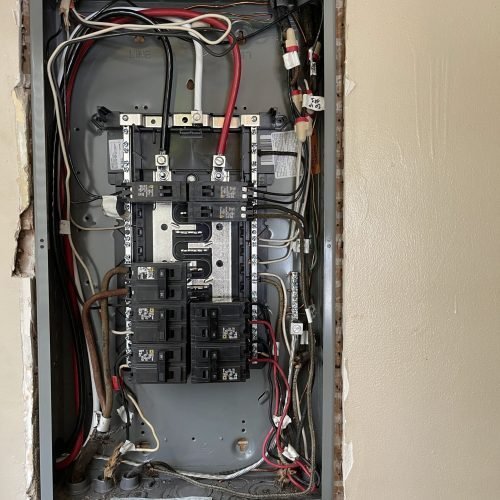
Plenty of electrical work rewards a careful homeowner. This isn’t it, for a reason that has nothing to do with skill: the conductors feeding your main breaker are energized from the utility side, so parts of the equipment stay lethal even with every breaker in the house switched off. There is no “flip the main and you’re safe” version of a service change. Professionals do this work with the utility disconnected at the street, on a scheduled window, precisely because no amount of caution substitutes for de-energized gear.
The paperwork consequences track the physical ones. Unpermitted service work can void insurance coverage after a fire, stall a sale when the buyer’s inspector finds it, and cost more to legalize afterward than it would have cost to do correctly once. Swap your own light fixtures with pride; leave the service equipment to someone whose license number goes on the permit.
What you can safely contribute is observation. Photograph your panel label, note the main breaker rating, keep a list of what trips and when, and gather your appliance details before the evaluation. Good information from the homeowner shortens the diagnostic half of the visit, and it costs nothing but attention.
When is a subpanel, or nothing, the smarter buy?
Not every crowded panel needs a service upgrade, and telling you otherwise would be selling, not advising. A subpanel is a satellite breaker box fed from your existing service, and it’s the right prescription when the load calculation shows genuine headroom but the panel is out of physical positions. Classic cases: a basement finish that needs six new circuits in a house running gas heat and gas appliances, or a detached garage workshop. You buy slots and shorter circuit runs without touching the meter, the mast, or the utility, which is why a subpanel typically prices far below a service change.
And sometimes the honest verdict is no work at all. A healthy 100-amp panel in a gas-served rambler with no EV, no spa, and no expansion plans is not a problem waiting to happen; it’s a correctly sized system doing its job. When we say that during an evaluation through our panel and meter upgrade service, we mean it, and the visit still leaves you with a documented load calculation for whenever plans change.
Quick answers
Does a panel upgrade increase home value?
It helps in a specific, measurable way: it removes a deal-friction point rather than adding a luxury. Buyers along the Wasatch Front increasingly arrive with EV plans, and their inspectors flag full panels, obsolete brands, and 60-amp services in writing. A documented, permitted 200-amp upgrade neutralizes that entire page of the inspection report, protects your negotiating position, and signals the rest of the house was maintained by someone who did things properly. Appraisers rarely line-item it; buyers absolutely price it.
How long is a panel upgrade timeline from first call to done?
Two to four weeks is the realistic envelope for most projects: an evaluation visit, a few days for the city permit, one to two weeks of utility lead time for the disconnect window, one day of installation, and a final inspection shortly after. Emergencies compress that; failed equipment gets prioritized.
Will my house be without power during the upgrade?
Yes, for most of the working day while the service is disconnected. Plan around it the way you would a short outage: keep fridge doors closed, charge devices the night before, and ask us about timing if someone in the home relies on powered medical equipment so we can plan accordingly.
Can I upgrade the panel now and add circuits later?
Absolutely, and it’s a sound strategy. The service change is the expensive, disruptive step; once a 200-amp panel with spare positions is on the wall, future circuits for a charger, spa, or basement finish become short, simple projects. If you already know a big circuit is coming, though, running it during the upgrade saves a second permit and visit.
Do smart panels or load-management devices change the math?
Sometimes. Load-management hardware can shed a big load like an EV charger when the service approaches its limit, which lets some 100-amp homes add a charger legally without a service change. It’s a legitimate tool, not a universal substitute: it manages scarcity rather than creating capacity.
What brand of panel will I end up with?
A current UL-listed panel from a major manufacturer with full breaker availability, sized with spare positions rather than filled to the last slot. The exact brand depends on supply and the job’s needs; what we won’t do is install anything obsolete, gray-market, or slot-starved on day one.
Does an upgrade fix aluminum branch wiring from the 1970s?
No, and it’s worth being clear about the boundary. The upgrade replaces service equipment; the branch wiring in your walls stays what it is. Aluminum branch circuits have their own remediation paths, from listed connectors at every device to selective rewiring, and a panel evaluation is a sensible time to have that separate conversation honestly.
Is a 60-amp or fuse-based service automatically an emergency?
Not an emergency, but a priority. Fuse services still function, and some are wired better than panels from the 1980s. The problems are capacity, the temptation of oversized fuses, and insurability, since many carriers now balk at 60-amp service. Treat it as a this-year project, not a this-weekend panic.
Wondering which chapter of this guide your house is living in? One evaluation visit answers it: load calculation, honest verdict, written quote, no pressure attached.
Copperview Electric is headquartered in Ogden, and the housing eras this guide keeps referencing are the streets we work every week. Our Ogden electrician page covers how we handle the city’s older panels, from the Avenues to the east bench.