
9 Signs Your Electrical Panel Is Overloaded or Obsolete
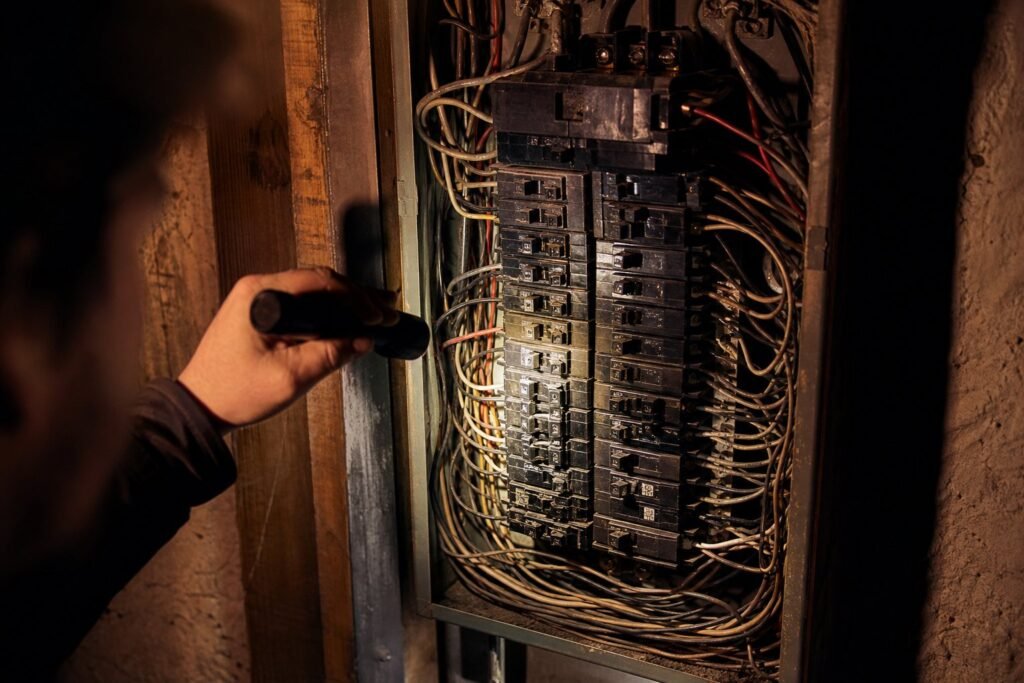
An electrical panel rarely fails without leaving a trail. Nine signs cover nearly every case: routine breaker trips, dimming lights under load, a warm or buzzing panel, burning odors or scorch marks, zero open slots, fuses or a 60-amp main, a flagged brand like Zinsco or Federal Pacific, visible rust or corrosion, and big electrical plans on your calendar. Two of those mean call now; the rest mean start planning.
In this guide
Which signs does your panel show you day to day?
The first five signs are behavioral: things you notice while living in the house. Any one of them is information; two or more of them together is a pattern.
1. Breakers trip on ordinary routines
A trip during a genuine overload is the system working. A trip every time the microwave and toaster share a morning, or whenever the vacuum meets a space heater, means your circuits and service no longer match how the house is actually used. Our breakdown of why breakers keep tripping separates the overload, short-circuit, and ground-fault cases; when trips are frequent and spread across circuits, the panel itself joins the suspect list.
2. Lights dim or flicker when appliances start
Watch what happens when the furnace blower, air conditioner, or garage door motor kicks on. A brief, repeatable dip in the lights means those motor start-ups are borrowing voltage from everything else, a classic capacity complaint. Whole-house flicker deserves particular respect, since it can also point at a loose service connection rather than simple overload.
3. The panel is warm, buzzing, or crackling
A panel should be room temperature and silent. Warmth on the dead front, a persistent hum louder than a faint transformer note, or any crackle or sizzle means current is meeting resistance somewhere it shouldn’t, usually at a deteriorating connection. Resistance makes heat, and heat inside an enclosure full of conductors is the beginning of a bad story.
4. Burning smells or scorch marks
A fishy or acrid odor near the panel, browned insulation, or dark streaks around a breaker are evidence of overheating that already happened. This is the sign that skips the waiting list: stop resetting anything, and get a professional in front of it promptly.
5. No open slots, and tandem breakers everywhere
Open the outer door and count. If every position is filled, and especially if narrow doubled-up breakers are already squeezing two circuits into single slots, your panel ran out of room at least one project ago. The next circuit you need has nowhere to go, which quietly vetoes future plans before you’ve made them.
Which signs live in the equipment itself?
The last four signs don’t depend on symptoms at all. A panel can behave flawlessly and still carry one of these.
6. Fuses, or a main rated 60 amps
Fuse boxes and 60-amp services still exist across Ogden’s older neighborhoods, and some are wired carefully. The trouble is threefold: capacity that predates air conditioning, the decades-old temptation of oversized replacement fuses defeating the protection, and insurers who increasingly decline the risk. Function isn’t the question; fitness for this century is.
7. A flagged brand on the label
Zinsco and Federal Pacific Stab-Lok panels carry documented histories of breakers failing to trip under fault, which converts them from “old equipment” to “known defect category” in inspection and insurance language. Identification takes one look at the door; our Zinsco and Federal Pacific guide shows exactly what to look for and what the record says.
8. Rust, corrosion, or water staining
Corrosion on the cabinet, breakers, or bus means moisture has been visiting, whether from a leaky meter mast, a damp basement wall, or decades of condensation. Corroded connections rise in resistance and fail hot, and moisture plus service equipment is a combination with no acceptable version.
9. Your plans outgrow the panel
An EV in the driveway, a hot tub on the patio drawings, a basement apartment, a shop in the garage: each is a large load or a batch of new circuits, and each begins with panel capacity. Planning the upgrade alongside the project, instead of discovering the constraint mid-project, is the difference between one permit cycle and two.
Which signs are urgent and which can wait?
Not all nine deserve the same adrenaline. Here’s the honest sorting:
| Urgency | Signs | What to do |
|---|---|---|
| Act today | Burning smells or scorch marks (4); crackling, sizzling, or a hot panel (3) | Stop resetting breakers and call for same-day service |
| Schedule this month | Routine trips (1); dimming under load (2); flagged brand (7); corrosion (8) | Book an evaluation; these compound quietly while you wait |
| Plan this year | Full panel (5); fuses or 60-amp main (6); upcoming big loads (9) | Fold the panel into your project budget and timeline deliberately |
Two of the nine signs are alarms. The other seven are appointments you get to schedule on your terms.
What does a panel evaluation involve?
An evaluation is diagnosis, not a sales visit, and it’s short. Ours runs like this:
- A visual pass over the panel, meter base, and mast, covers on, checking brand, rating, condition, and workmanship.
- A load calculation from your square footage and appliance list, which converts “feels full” into a number.
- Thermal and connection checks where symptoms justify opening the dead front, done by us, not you.
- A straight verdict: repair, subpanel, full upgrade, or leave it alone, each with a written price.
That last option is real. When the math says your panel is fine, you’ll hear exactly that. When it doesn’t, our panel and meter upgrade service takes the project from quote through city inspection, and the complete panel upgrade guide shows every step before you commit to any of them.
Cost context up front: a typical Utah 100-to-200-amp upgrade runs $1,500–$3,000, a subpanel usually costs a fraction of that, and an evaluation tells you which column you’re in before you spend either number.
When is the panel innocent?
Sometimes the symptom list points elsewhere, and replacing the panel would just be an expensive way to keep the problem. One device tripping one breaker is usually the device. A single flickering fixture is a fixture or switch issue. A GFCI outlet that trips in one bathroom is doing local protection work that has nothing to do with service capacity. Even whole-house flicker occasionally traces to the utility’s connection rather than anything you own.
This is why the evaluation comes before the quote instead of after. Panels get replaced for panel reasons: capacity, condition, brand, or room to grow. If your house has a wiring gremlin instead, troubleshooting is cheaper and actually fixes it. The panel upgrade guide lays out the whole decision honestly, including the paths that end with keeping what you have.
Quick answers
How many of the nine signs justify an upgrade?
It’s weight, not arithmetic. Sign 4 alone means act now; sign 7 alone usually justifies replacement regardless of behavior. The milder signs earn an evaluation when two or three stack up, because they compound: a full panel plus dimming plus an EV on order is one project pretending to be three annoyances.
Can I check for these signs safely myself?
Seven of the nine, yes: everything visible with the outer door open plus your own observations of trips, dimming, and smells. Never remove the inner metal cover; the wiring behind it stays energized in places even with the main off. Anything requiring tools or testing is the professional half of the job.
My panel shows zero signs. Should I still do anything?
Just awareness. Know your main breaker rating, keep the panel accessible rather than buried behind storage, and revisit the question when plans change, an EV, a spa, a basement finish. A symptom-free, correctly sized panel needs nothing sold to it, and we’ll tell you so.
Do these signs mean fire risk right now?
Mostly no. Signs 3 and 4 involve active heat and deserve same-day attention. The others are capacity and obsolescence problems that develop over months and years, which is exactly why they reward planned, permitted work over 2 a.m. emergencies. The goal of the list is to keep you in the first category.
Does homeowners insurance care about any of this?
Increasingly, yes. Carriers commonly ask about panel brand, fuse service, and amperage on older homes, and some condition coverage on replacement. A permitted upgrade with a closed inspection is the documentation that ends those conversations.
Counting two or more signs from this list? Get the load calculation and a straight answer. If the panel is fine, we’ll say so and shake hands.
Roy’s post-war blocks are full of panels wearing signs five and six, and we’re there constantly. Our Roy electrician page explains how we work in the city’s housing stock.