
Flickering or Dimming Lights: The 7 Causes, From Harmless to Urgent
Flickering or dimming lights come from seven causes, and the fix ranges from tightening a bulb to calling the utility. In rough order of severity: bulb and dimmer mismatch, a loose bulb or fixture, appliance motor start-up dips, an overloaded circuit, a loose neutral at a device, failing panel connections, and utility-side service problems. One flickering lamp is a chore. The whole house flickering is a phone call, today.
In this guide
Which flicker pattern do you have?
Match your symptom to the pattern before touching anything, because the spread of the flicker tells you most of the story. One lamp means the lamp. One room means the circuit. The whole house means the panel or the service, and that end of the table is where the urgency lives.
| Symptom pattern | Likely cause | What to do |
|---|---|---|
| One bulb flickers, others on the switch are fine | Loose or dying bulb, worn socket | Tighten or replace the bulb |
| LEDs flicker only when dimmed | Dimmer and bulb mismatch | Fit an LED-rated dimmer or listed bulbs |
| Brief dim when furnace, AC, or fridge starts | Motor inrush current | Normal if quick and consistent; watch the trend |
| Lights sag while several things run on one circuit | Overloaded circuit | Move loads; add a circuit if it’s chronic |
| One room or circuit flickers randomly, any load | Loose neutral or failing device connection | Stop using the circuit; book a repair |
| Multiple rooms flicker, breakers warm or buzzing | Failing panel connections | Call an electrician now |
| Whole house flickers, worse in canyon wind | Utility service drop or meter connection | Call now; may involve Rocky Mountain Power |
One lamp is a chore, one room is a repair, the whole house is a phone call.
Which flickering causes are harmless?
1. Bulb and dimmer mismatch
LEDs on an old incandescent dimmer flicker because the dimmer chops power in a way cheap LED drivers can’t smooth out, especially at low settings. Nothing is failing and nothing is dangerous; the parts just don’t speak the same dialect. An LED-rated dimmer, or bulbs listed as compatible with your dimmer model, ends it. This exact scenario has enough wrinkles that we gave it its own post on why LED lights flicker, including the shared-neutral and smart-bulb cases.
2. A loose bulb or fixture connection
A bulb backing out of its socket flickers as the contact makes and breaks. Kill the switch, let it cool, and snug it. If the same socket keeps producing flickers with known-good bulbs, the socket’s spring tab has flattened or the fixture’s wiring connection is loosening, which quietly promotes this from cause 2 to cause 5. A fixture that flickers with a tight, fresh bulb has earned a look.
Why do lights dim when an appliance kicks on?
Cause 3 is motor inrush, and it’s the most misread symptom on this list. Compressors and blower motors draw several times their running current for the first moments of start-up, and that surge drags voltage down everywhere nearby. The lights record the dip like a seismograph. Quick, shallow, and tied to the same appliance every time means your wiring is doing its job under a heavy ask.
Judge it by trend, not by the single event. A dip that deepens over months, starts arriving with appliances it never used to notice, or spreads from the kitchen circuit to the bedroom lights is describing a connection getting worse somewhere upstream. Homes on older 60–100A services feel inrush harder because the start-up surge is a bigger slice of a smaller pie; the capacity side of that story lives in our home electrical problems guide.
What if the flicker lives on one circuit?
4. An overloaded circuit
Lights that sag whenever the space heater, microwave, and TV share one circuit are reporting arithmetic: the circuit is delivering everything it has, and voltage drops under the load. The short-term fix is free, moving big loads to outlets on other circuits. The honest long-term fix for a chronically overloaded circuit is adding one, which is ordinary repair work, not a project.
5. A loose neutral or failing device connection
This is where flickering stops being cosmetic. A loose neutral at a receptacle or splice makes voltage swing as the connection shifts, so lights on that circuit flicker randomly, under any load, sometimes with a faint crackle from the device doing the arcing. Every make-and-break at that joint is a tiny arc, and arcs build carbon and heat. You can bracket the suspect yourself the safe way:
- Note exactly which lights and outlets flicker together; that group shares the faulted path.
- Unplug everything on the group and see whether the flicker continues with only fixed lighting running.
- Feel plates on that run with the back of your hand for warmth, and listen for crackle at switches and receptacles.
- Found warmth, crackle, or any burnt smell? Stop using the circuit at the breaker and book the repair; the remaining work is inside live boxes.
When does flickering mean the panel or the service?
6. Failing panel connections
Flickering across multiple circuits that share nothing but the panel points at the panel: a breaker no longer gripping its bus, a corroded neutral bar, or a main lug working loose. Supporting evidence includes breakers that run warm, buzzing or sizzling from the panel, and circuits that misbehave together in patterns no room layout explains. Panel interiors stay energized even with the main off, so this diagnosis belongs entirely to a licensed electrician. Treat it as a this-week call, and as a today call if you hear buzzing or smell heat.
7. Utility-side and service drop problems
When the whole house flickers at once, especially in wind, the fault is often upstream of everything you own: the service drop connections at the weatherhead, the meter base, or the utility’s splices. Canyon wind events along the Wasatch Front are famous for shaking marginal overhead connections into confession. Whole-house flicker is a call-now symptom because the same loose connection can become a lost leg or take out sensitive electronics. An electrician can determine which side of the meter owns the fault; if it’s the utility’s, Rocky Mountain Power repairs their equipment at no cost to you. If the failure is active, arcing, or accompanied by burning smells, that’s the territory of our guide to electrical emergencies.
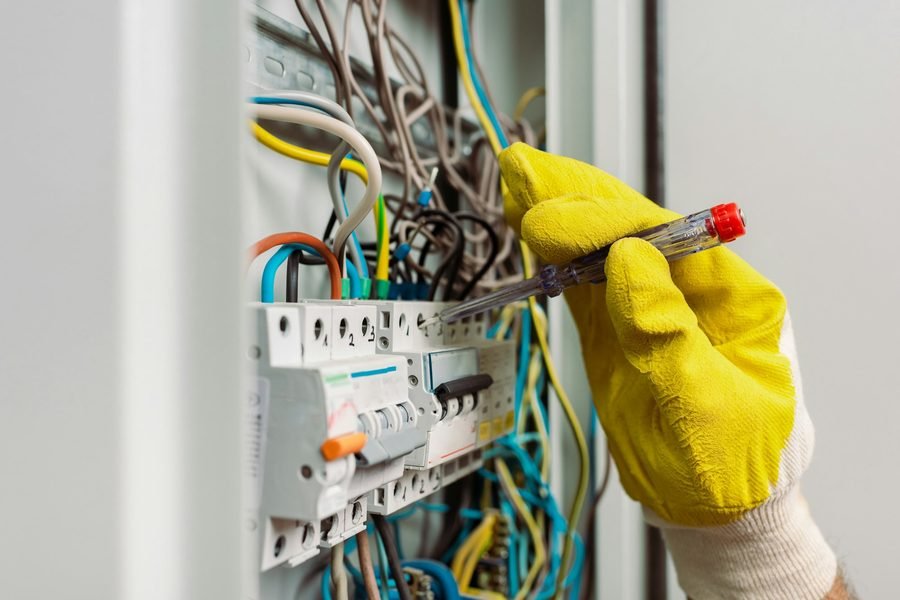
Call-now rule: flickering that covers the whole house, arrives with buzzing or burning smells, or coincides with a breaker that keeps tripping has jumped the queue. Skip the bulb-tightening and call.
When is flickering not worth paying to fix?
Causes 1 through 3 rarely justify a service call on their own, and we’d rather say so than bill you to tighten a bulb. A mismatched dimmer is a hardware-store fix. A brief, stable dip when the furnace starts is a fact of motor physics that no repair will erase. Even cause 4 costs nothing if moving the space heater to another circuit solves your evening.
Spend money when the pattern says connection: randomness, spread, warmth, sound, or smell. And if you’re unsure which side of the line you’re on, describe the pattern over the phone. Our diagnostic guide exists so you can locate yourself before paying anyone, and our post on electrician costs in Utah tells you what the visit runs if it comes to that.
Quick answers
Are flickering lights a fire risk?
Depends entirely on the cause. Bulb, dimmer, and motor-inrush flicker carries no fire risk. Flicker from a loose neutral, a failing device, or a deteriorating panel connection is arcing, and arcing is how electrical fires start. Random flicker on one circuit, or any flicker with warmth or a burning smell, deserves prompt professional attention.
Why do my lights flicker in the wind?
Wind-synced flicker points to the overhead service drop or weatherhead connections moving, which means a marginal connection upstream of your panel. It won’t heal, and it can progress to a lost leg. Have it assessed; if the fault sits on the utility side of the meter, Rocky Mountain Power repairs their own equipment.
Can one bad breaker make lights flicker?
Yes. A breaker that has lost its grip on the panel bus, or whose internal contacts are worn, delivers intermittent voltage to everything on its circuit. The tell is flicker confined to one circuit plus a breaker that runs warmer than its neighbors. Replacing a breaker is quick, licensed work; the diagnosis is the valuable part.
Do LED bulbs flicker more than incandescents?
They reveal more. An incandescent filament’s glow smooths over tiny voltage wobbles that an LED driver reproduces faithfully, so LEDs expose dimmer mismatches and marginal connections that incandescents hid. That sensitivity is annoying with a cheap dimmer and genuinely useful as an early-warning light for wiring problems.
Whole-house flickering stopped on its own. Am I fine?
Treat it as a warning that went quiet, not a problem that left. A loose service connection makes and breaks contact with temperature, load, and wind, and each reconnection arcs. Intermittent whole-house flicker is exactly how failing service connections behave early. A one-visit assessment settles whose side of the meter it’s on.
Describe your flicker pattern to us, which rooms, what triggers it, how long it’s been building, and we’ll tell you straight whether it’s a bulb, a circuit, or a call-now problem.
We diagnose flickering from bench homes to new builds all over the area, and our South Ogden electrician page covers how we handle the mixed-era housing along the east bench specifically.