
Diagnosing Home Electrical Problems: A Homeowner’s Guide
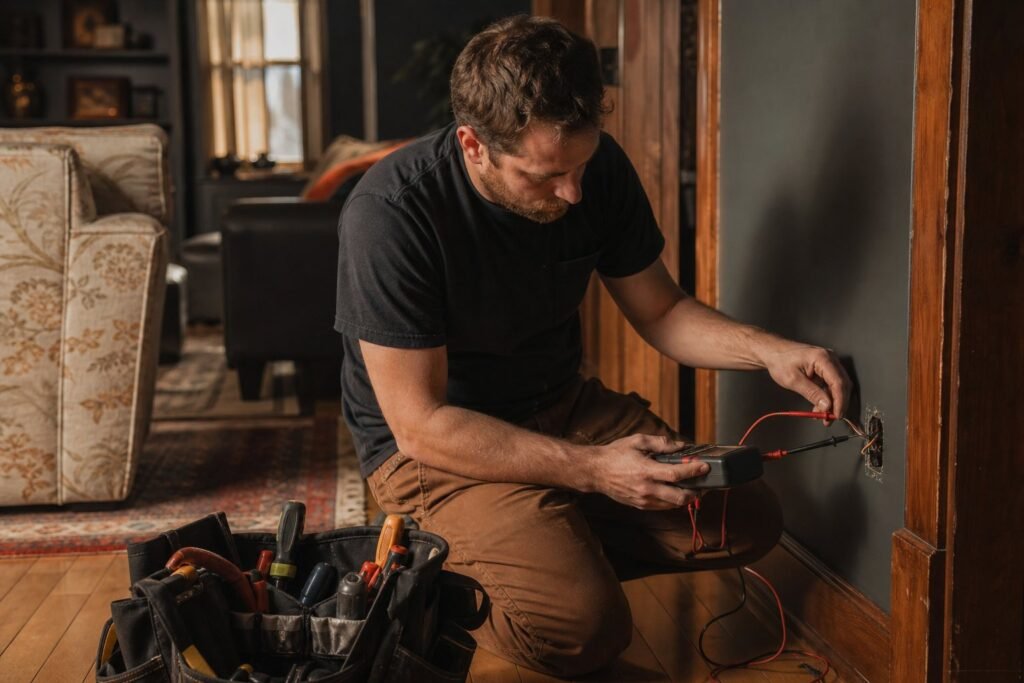
Most home electrical problems trace back to a short list of causes: a tripped GFCI hiding in another room, a breaker that quietly gave up, a worn or loose connection building heat, or a service problem upstream of your panel. This guide follows the same diagnostic order a licensed electrician uses on a service call, shows what you can safely check yourself in an Ogden-era home, and is blunt about the exact point where homeowner troubleshooting has to stop.
In this guide
- What your symptom usually means
- How do you trace a dead outlet?
- Why do lights flicker when an appliance starts?
- What if half the house is out?
- Are warm outlets or switch plates dangerous?
- What actually counts as an electrical emergency?
- Does my 1970s home have aluminum wiring?
- How do you keep wiring from starting a fire?
- How far should DIY diagnosis go?
- How does a pro actually find the fault?
- Is old wiring automatically a problem?
- Quick answers
What does your symptom usually mean?
Start with the pattern, because the pattern narrows the cause faster than any single test. One dead outlet points one direction; a whole side of the house gone dim points somewhere else entirely. The table below is the mental map we carry into troubleshooting calls across Weber and Davis counties, condensed to the checks a homeowner can make from the hallway.
| Symptom | First check | Most likely cause | Urgency |
|---|---|---|---|
| One dead outlet | GFCI buttons, then the breaker panel | Tripped GFCI upstream or a failed backstab connection | Diagnose this week |
| Several dead outlets in one area | GFCIs in the bathroom, garage, and outside | One upstream GFCI feeding the whole chain | Diagnose this week |
| Lights dim briefly when the furnace or fridge starts | How deep the dip is and how long it lasts | Normal motor inrush, or a loose neutral if it’s worsening | Watch it; call if it grows |
| Half the house dead or dim | Whether 240V appliances act strangely | A lost service leg at the meter, mast, or utility connection | Call the same day |
| Warm outlet or switch plate | What’s plugged in or on that switch | Overloaded cord equipment or a loose termination heating up | Stop using it and call |
| Burning smell, sparking, or buzzing | Nothing yourself | Arcing at a connection | Breaker off, call now |
The pattern of a failure tells you more than the failure itself.
Each row of that table gets its own section below, in the order we’re actually asked about them. Read your row first, then come back for the three sections at the end: where DIY has to stop, how a professional isolates a fault, and the honest case for leaving old wiring alone. Together they’re the difference between describing a problem to an electrician and handing one over half-solved.
How do you trace a dead outlet?
A dead outlet with no tripped breaker is the single most common repair call we run, and about half of them end at a GFCI the homeowner didn’t know existed. Code has required ground-fault protection in wet locations for decades, and builders often satisfied it by wiring one GFCI receptacle to protect everything downstream: a bathroom GFCI can silently control the other bathroom, the garage, and the porch. When that one device trips, every outlet behind it plays dead.
Run the trace in this order before you call anyone:
- Press reset on every GFCI in the house: bathrooms, kitchen, garage, basement, exterior covers. Push firmly until it clicks. This resolves more dead outlets than any other step.
- Open the panel door and scan for a breaker sitting between on and off. A tripped breaker rarely flips all the way; it drifts to the middle. Push it fully off, then back on, once.
- Plug a lamp you trust into the dead outlet and into its neighbors. Map exactly which outlets are out; the shape of the dead zone is the clue an electrician will ask about.
- If a light switch near the outlet does nothing obvious, try it anyway. Builders wire half-hot outlets controlled by a wall switch, and a bumped switch imitates a failure.
- Still dead with the breaker on and every GFCI reset? Stop there. The likely fault is a failed connection inside the box, and that’s tool work on live parts.
The connection that fails is usually a backstab: a push-in terminal on the back of a cheap receptacle where the wire is held by spring tension alone. Builders loved them because they save minutes; electricians dislike them because the spring relaxes over years of heat cycles, the contact loosens, and the outlet starts dropping power intermittently before it dies. Every device downstream on that circuit can go dark from one bad backstab, which is why a dead outlet in the bedroom sometimes gets fixed in the hallway.
Why do lights flicker when an appliance starts?
A brief dim when the furnace, fridge, or garage compressor kicks on is usually physics, not failure. Electric motors draw several times their running current for the first fraction of a second, and that inrush pulls voltage down across the whole circuit until the motor spins up. If the dip is quick, shallow, and tied to the same appliance every time, your wiring is passing a stress test, not failing one.
The line between normal and worrying is drawn by three things: depth, spread, and trend. A flicker that gets deeper over months, that spreads to circuits unrelated to the appliance, or that shows up with no motor starting at all deserves a professional look, because those patterns point at a loose or corroded connection rather than inrush. We break down all seven causes, ranked from harmless to urgent, in our guide to flickering and dimming lights.
Homes on the post-war benches above Ogden and Roy add a wrinkle: many still run 60–100A services sized for a 1950s appliance load. On a small service, a big motor start borrows a larger share of the available capacity, so the dip is more visible. That’s a capacity question as much as a repair question, and our panel upgrade guide covers how to tell which one you’re facing.
What does it mean when half the house is out?
Half the house dead or dim, while the other half works, means you’ve likely lost one of the two 120-volt legs that feed your panel. Residential service arrives as two hot legs; roughly half your circuits hang off each one. When a leg fails at the weatherhead, the meter base, or a main lug, everything on that leg goes dark while the rest of the house carries on as if nothing happened.
The symptoms are distinctive once you know them. Everything on the dead leg is out or browned-out, while 240-volt appliances, which straddle both legs, behave strangely: the dryer hums but won’t heat, the range clock works while the burners don’t. Sometimes lights on the failing leg glow dim instead of dying entirely, because power is backfeeding through those 240V appliances in ways their designers never intended.
This one is a call, not a project. A lost leg can put strange voltages on 240-volt appliances, and the failure point is often at connections only the utility or a licensed electrician should touch. Flip off your major 240V breakers (range, dryer, AC) to protect the equipment, check whether neighbors have power, and then make two calls: Rocky Mountain Power if the problem is on their side of the meter, and an emergency electrician if it’s on yours. If you can’t tell whose side it’s on, start with whoever answers first; either of us can rule our side out quickly.
Worth knowing: a half-out house sometimes flickers back to life on its own as the failing connection makes and breaks contact. Treat the recovery as a warning, not a fix. A connection that arcs under load is building heat every time it reconnects.
Are warm outlets or switch plates dangerous?
A warm plate is your wiring telling you where the resistance is, and resistance in the wrong place becomes heat, then damage, then risk. That said, two warm plates are normal and worth ruling out first. Dimmer switches shed heat by design and commonly run warm to the touch under a full load of bulbs. Transformers on low-voltage lighting do the same. Warm and stable, on a device built to run warm, is fine.
A warm receptacle plate is a different story. Receptacles have no business generating heat; when one does, current is squeezing through a connection that has loosened, corroded, or burned. The usual suspects are a space heater or window AC drawing near the circuit’s limit through a worn contact, a backstabbed connection on its way out, or in 1970s homes, an aluminum termination doing what aluminum terminations do. Unplug whatever’s feeding the heat, leave the plate alone, and put it on the list for a repair visit. If the plate is hot rather than warm, or discolored, or the outlet smells of anything at all, skip the list and treat it as urgent; our answer post on burning smells from outlets covers exactly what to do in that moment.
What actually counts as an electrical emergency?
An electrical emergency is any situation where heat, arcing, or shock risk is active right now: a burning smell you can’t immediately explain, an outlet or switch that sparked more than the faint static of unplugging, a panel that’s hot or buzzing, a breaker that re-trips instantly, anyone shocked by an appliance, or water reaching live equipment. Those get a breaker turned off and a phone call today, not a spot on the weekend list.
Two clarifications keep this honest. First, a downed power line is not an electrician call at all: stay far back, keep others back, and call 911 and Rocky Mountain Power. Second, most electrical annoyances are not emergencies. A single flickering bulb, one dead outlet, a breaker that tripped once under a space-heater load: those deserve diagnosis, not panic. The full first-five-minutes playbook, scenario by scenario, is in our guide to electrical emergencies, and when a situation does cross the line, our emergency service covers Weber, Davis, Morgan, Box Elder, and Cache counties with same-day response.
Does my 1970s home have aluminum wiring, and how bad is it?
If your home was built or expanded between about 1965 and 1973, there’s a real chance its branch circuits were wired in single-strand aluminum, because copper prices spiked and builders across the Wasatch Front, like builders everywhere, switched. Layton, Roy, Clearfield, and the subdivisions that filled in around Hill AFB during those years are where we encounter it most. You can sometimes spot it at the panel: cable jackets printed AL or ALUMINUM where they enter, and silver-colored conductors on breaker terminations. Confirming it, though, is inspection work, not a flashlight glance.
The problem was never the aluminum in the walls; it’s the connections at the ends. Aluminum expands and contracts more than copper with every heating cycle, and it oxidizes where copper doesn’t. At terminations designed for copper, those two habits slowly loosen the joint, resistance climbs, and the connection heats. The classic symptoms are warm plates, flickering on specific circuits, and devices that fail young.
Here’s the part the scare-marketing leaves out: aluminum branch wiring has recognized, code-accepted repairs that don’t involve gutting your walls. The proven approaches are COPALUM crimp connections installed with certified tooling, AlumiConn lug connectors as a widely used alternative, and CO/ALR-rated switches and receptacles at device connections. A full copper rewire is the most complete fix and sometimes the right one during a major remodel, but it is rarely the only responsible option. If you’re planning wall-open work anyway, our home wiring projects guide covers when a rewire piggybacks sensibly on a remodel.
How do you keep wiring problems from becoming a fire?
Electrical fires are overwhelmingly connection fires: heat building at a loose joint, a worn device, or an overloaded cord until something adjacent ignites. That means prevention is less about fear and more about removing the specific conditions that build heat. The habits below cost little and do most of the work.
- Give heat-making appliances their own outlet. Space heaters, toaster ovens, and portable ACs go straight into the wall, never into a power strip or extension cord. Cords and strips are where overload fires start.
- Take a re-tripping breaker seriously. One trip is protection working. A breaker that trips again on reset is protection repeating itself; stop resetting and find out why.
- Replace crackling, loose, or hot devices promptly. A receptacle that no longer grips a plug firmly has worn contacts, and worn contacts arc.
- Let AFCI protection do its job. Arc-fault breakers detect the signature of arcing before it becomes ignition. Panels from the 1990s and earlier predate them; adding AFCI protection during other panel work is cheap insurance.
- Test smoke alarms and put one near the panel and laundry. Not prevention, but the difference between an incident and a tragedy.
Utah winters deserve their own sentence here. Cold snaps stack loads that never run together in July: furnace blower, heat tape, space heaters in the cold bedrooms, holiday lighting, and an engine-block heater or EV charger in the garage. Marginal connections that behaved all summer start heating in January because the current through them doubled. If your breakers get busy every winter, that’s a capacity-and-connections conversation worth having in October, not during the first cold week when every electrician’s phone is ringing.
Panel-era hardware matters here too. Certain legacy panels, Zinsco and Federal Pacific among them, earned documented reputations for breakers that fail to trip under fault. If your panel wears one of those names, that’s a distinct issue from anything in this guide, and our panel upgrade guide walks through it without the hysteria.
How far should DIY diagnosis go?
You can safely do everything that doesn’t expose a conductor, and that’s more useful than it sounds. Resetting GFCIs and breakers, swapping bulbs, unplugging suspect appliances, mapping which outlets are dead, noting when a flicker happens and what triggers it: a homeowner who arrives at the phone call with that information saves real diagnostic time, and diagnostic time is what a troubleshooting visit bills for. Our post on what electricians cost in Utah breaks down how that time turns into a number.
The line sits exactly where a screwdriver meets a cover plate. Behind every plate are terminations that may be energized even with the switch off, because switches interrupt one conductor, not the box. Behind the panel’s inner cover are lugs that stay live even with the main breaker off. And any repair, as opposed to a reset, means working the connection itself: the precise part of the system where the fault, and the hazard, lives. Utah lets homeowners pull permits for some work on their own homes, but troubleshooting live faults is not where to spend that privilege.
The honest rule: if the next step requires a tool, it requires a license. Everything before that point, do freely and tell us what you found.
How does a professional actually find the fault?
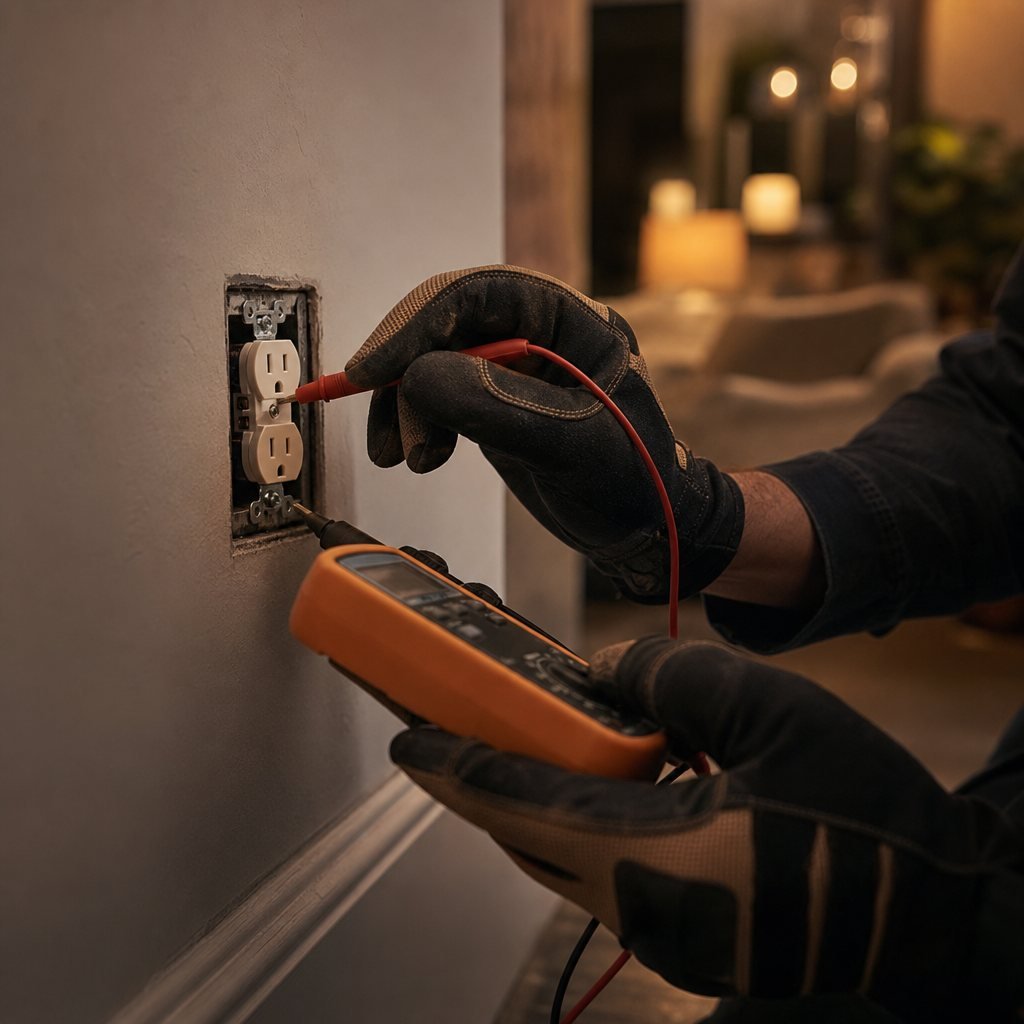
Methodical isolation, not intuition. A good troubleshooter treats the circuit as a chain and keeps cutting it in half until the fault has nowhere left to hide. The interview comes first: what died, when, what was running, what changed recently. Then the meter comes out, because a receptacle can look fine and read wrong, and voltage under load tells the truth that voltage at rest hides.
From there the sequence is repeatable: confirm the breaker and GFCI state, measure at the dead device, then split the circuit at accessible boxes to bracket the failure between two known points. A reading that’s solid at the fourth box and dead at the fifth puts the fault in one wall span, not somewhere in the house. Loose neutrals show up as voltage that swings when load is applied; failing terminations show up as heat, sometimes literally, on a thermal image. The fix itself is often minutes: re-terminate a backstab onto the screws, replace a burned device, tighten what worked loose. The value is in finding the right minutes.
Is old wiring automatically a problem?
No, and an electrician who implies otherwise is selling, not diagnosing. Age alone is not a defect. Ogden’s pre-war Avenues are full of homes whose original copper, where it has been kept dry, unmodified, and unstressed, still tests sound after ninety years. Copper doesn’t wear out from carrying current; systems fail at connections, at overloaded circuits, and at the amateur splices that decades of owners layered on top.
What old systems genuinely lack is capacity and protection: fewer circuits than modern life wants, no grounding conductor on the oldest runs, no GFCI or AFCI protection unless someone added it. Those are upgrade conversations with real answers and real prices, not reasons to condemn a house. The fair way to settle the question is an electrical inspection that grades condition rather than birthday: insulation integrity, connection quality, panel health, protection coverage. Plenty of those inspections end with us telling the owner their wiring is fine, and we’d rather keep that reputation than invent a rewire.
Quick answers
Why is one outlet dead when no breaker is tripped?
Almost always a tripped GFCI somewhere upstream or a failed connection at a receptacle earlier in the circuit, commonly a push-in backstab terminal that lost its grip. Reset every GFCI in the house first, including garage and exterior ones. If the outlet stays dead, the fault is inside a box and needs a licensed repair.
Is it safe to reset a tripped breaker?
Once, yes. Flip it fully off, then on, and note what was running when it tripped. If it holds, you likely overloaded the circuit. If it trips again immediately or under the same load, stop resetting; repeated trips mean a fault or overload that needs diagnosis, and forcing a breaker to keep interrupting it builds heat.
What does a fishy or burning-plastic smell near an outlet mean?
Overheating insulation, and it’s the classic pre-fire warning. Turn off the breaker feeding that outlet, leave anything plugged into it alone until it cools, and call the same day. The smell fading afterward does not mean the damage healed; the char and the loose connection are still there.
Do two-prong outlets have to be upgraded?
Not by any retroactive rule; existing two-prong receptacles are generally allowed to remain. When you want three-prong convenience without rewiring, code permits GFCI protection with a “no equipment ground” label as an accepted path. A grounding conductor is better; it just isn’t mandatory to add on a functioning old circuit.
Why do my lights dim for a second when the AC starts?
Motor inrush. Compressors briefly draw several times their running current, and the voltage dip shows up as a flicker. Quick, shallow, and consistent is normal. Deeper over time, spreading to unrelated circuits, or happening with no motor starting points to a loose connection and deserves a professional look.
How much does it cost to have an electrician diagnose a problem?
In Utah, expect a service call in the $75–$150 range, often credited toward the repair, with hourly troubleshooting around $85–$150. Simple fixes like a failed receptacle usually land near the minimum. Good notes about symptoms and timing genuinely shorten the bill.
When should I call the utility instead of an electrician?
Anything on the street side of the meter: downed or sagging lines, a damaged service drop, the whole neighborhood dark, or a tree in the lines. That’s Rocky Mountain Power, or 911 first if a line is down. From the meter into the house, including a lost leg at your panel, is electrician territory.
Can I legally do my own electrical work in Utah?
Utah generally allows homeowners to perform electrical work on their own primary residence under a homeowner permit, with the same inspections a contractor’s work gets. Legal and wise aren’t the same thing, though: troubleshooting live faults and panel work carry real hazards, and unpermitted work of any kind surfaces at insurance claims and home sales.
Chasing a fault that keeps outsmarting the breaker box? Describe the pattern to us and we’ll tell you honestly whether it needs a visit, and what that visit costs, before anyone drives anywhere.
Copperview Electric is based in Ogden, and most of the failure patterns in this guide walked through our door from Ogden housing stock first. If that’s your city, our Ogden electrician page covers how we work in everything from Avenues-era bungalows to bench-top ranchers.