
Is a Burning Smell From an Outlet an Emergency?
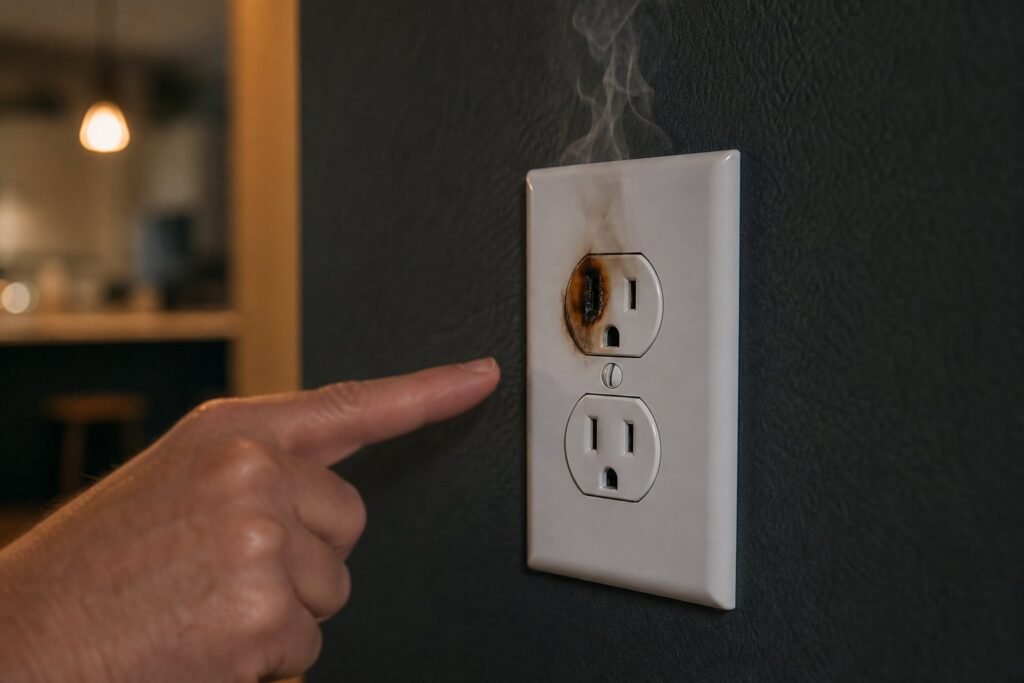
Yes. Treat a burning smell from an outlet as an emergency. Turn off that circuit’s breaker right now, leave whatever is plugged in exactly where it is while the outlet is hot, and call an electrician today. That fishy or hot-plastic odor is insulation overheating inside the wall, and it is the classic warning that arrives before an electrical fire.
In this guide
Why does an outlet smell like burning fish or plastic?
The smell is insulation and plastic components cooking, and the fish note is specific: heated phenolic resin, the material in receptacles and wire insulation, gives off that odor as it breaks down. Something at that outlet is running far hotter than design, and there are three usual reasons.
| Cause | What’s happening | Typical tell |
|---|---|---|
| Loose connection arcing | A wire termination has worked loose and current jumps the gap, generating intense local heat | Smell comes and goes; faint crackle or sizzle |
| Overloaded device | A space heater or similar heavy load pulls near the circuit’s limit through worn contacts | Warm plate, plug hot to the touch, smell under load |
| Failing receptacle | Decades of plug cycles have worn the contacts until they grip poorly and heat | Plugs sit loose or fall out; discoloration around the slots |
All three end the same way if ignored: heat builds at the connection, insulation chars, and charred material eventually tracks current or ignites. The smell is the early chapter of that story, which is why it belongs in the emergency column of our home electrical problems guide.
What should you do in the next five minutes?
- Go to the panel and turn off the breaker feeding that outlet. Can’t tell which one? Shut off the main; a dark house is a cheap trade.
- Leave plugged-in cords alone until the outlet is dead and cool. Pulling a plug from an arcing receptacle puts your fingers at the fault.
- With power off, check the plate with the back of your hand and look for scorch marks or melting. Don’t remove the plate.
- See flame, heavy smoke, or a smell that intensifies after the breaker is off? Get everyone out and call 911.
- Situation stable? Call an emergency electrician and keep the circuit off until it’s inspected. Not tomorrow: heat damage doesn’t schedule around weekends.
Keep in mind: a breaker will not necessarily trip for this. Breakers respond to overcurrent, and a loose connection arcs and cooks at currents the breaker considers polite. Silence from the panel is not evidence of safety.
It stopped smelling. Does that mean it fixed itself?
No. Loose connections heat under load and cool at rest, so the smell fades every time the space heater cycles off or the toaster finishes. The charred insulation, the carbon tracking, and the loose termination are all still in the box, and carbon is conductive: each new heat cycle starts from a worse baseline than the last. This on-and-off pattern is exactly how receptacle fires incubate for weeks before igniting.
The honest flip side: a one-time faint whiff with an obvious external cause, a new appliance’s coating curing, dust burning off a heater’s element, isn’t a wiring emergency, and we won’t pretend it is. The test is the source. Smell traceable to the appliance, moving with the appliance when you relocate it, points at the appliance. Smell that stays with the outlet, recurs, or pairs with warmth at the plate is the wiring, and it stays in the emergency column. Our guide to electrical emergencies covers how to triage the ambiguous cases in the moment.
A smell that comes and goes is a fault that heats and cools, not a problem that left.
What does the repair involve?
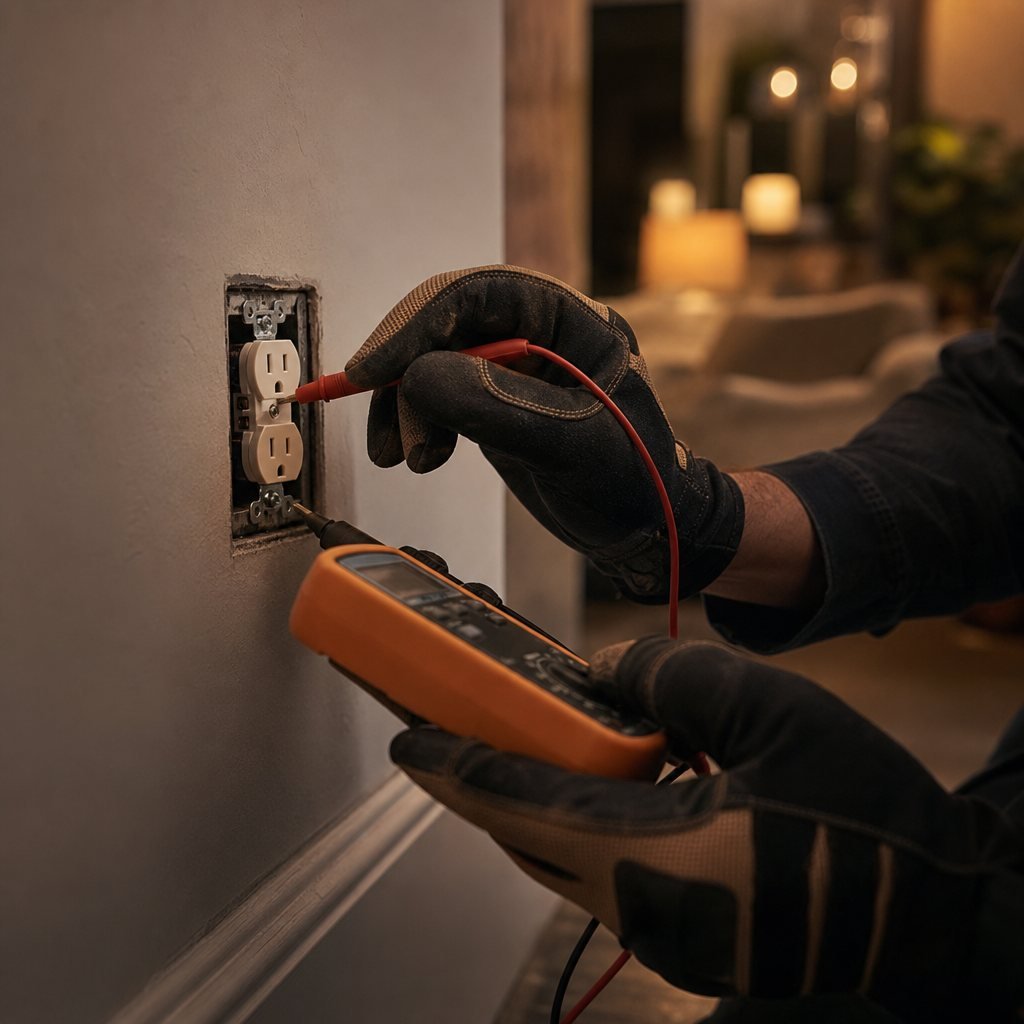
Usually less than the smell suggests. The electrician kills and verifies the circuit, opens the device, and reads the damage: how far the char extends and whether the conductors themselves cooked. A typical fix means cutting back damaged wire to clean copper, replacing the receptacle with a spec-grade device terminated on the screws rather than the push-in backstabs, and checking the neighboring devices on the circuit, since the same installer habits usually repeat down the line.
Cost-wise, a straightforward burned-receptacle repair lands near the service-call minimum, commonly $75–$150 plus modest parts, while charring that has traveled up the cable means replacing a wire run and more labor. Either way it’s ordinary repair and troubleshooting work with a flat quote before anything is opened, and it’s among the highest-value repairs in the trade: you’re buying out a fire that had already introduced itself.
Quick answers
Can I just stop using the outlet instead of fixing it?
Turning off the breaker and leaving it off is safe as a stopgap; simply not using the outlet is not. The damaged connection may sit mid-circuit, carrying current to everything downstream even with nothing plugged in. Until it’s inspected, the breaker is the only off switch that counts.
Why didn’t my breaker trip if the outlet was burning?
Standard breakers trip on overcurrent, and an arcing loose connection generates fierce local heat at normal current levels the breaker has no reason to question. This gap is exactly why AFCI breakers exist; they listen for the electrical signature of arcing rather than waiting for an overload.
Is a fishy smell always electrical?
Treat it that way until proven otherwise. Heated electrical components produce a distinct fishy odor as their insulation breaks down, and it’s frequently mistaken for food, a pet accident, or a dead rodent while the real source cooks inside a wall. If the smell recurs near any outlet, switch, or fixture, check there first.
Should I plug the appliance into a different outlet?
Not until you know which side failed. If the appliance’s cord or plug overheated, it will repeat the performance on a healthy outlet. Inspect the plug for discoloration or melted spots, and if the cord end shows any damage, the appliance is done until repaired. When the plug looks clean and the outlet shows the damage, the outlet was the problem.
Smelling it right now? Breaker off first. Then call and we’ll walk through it with you on the phone, including an honest read on whether it needs us tonight or first thing tomorrow.
Copperview handles burned-outlet calls across Weber and Davis counties, and our Roy electrician page covers how we respond in Roy’s post-war neighborhoods, where worn receptacles on original circuits are a recurring find.