
Electrical Emergencies: What to Do in the First 5 Minutes
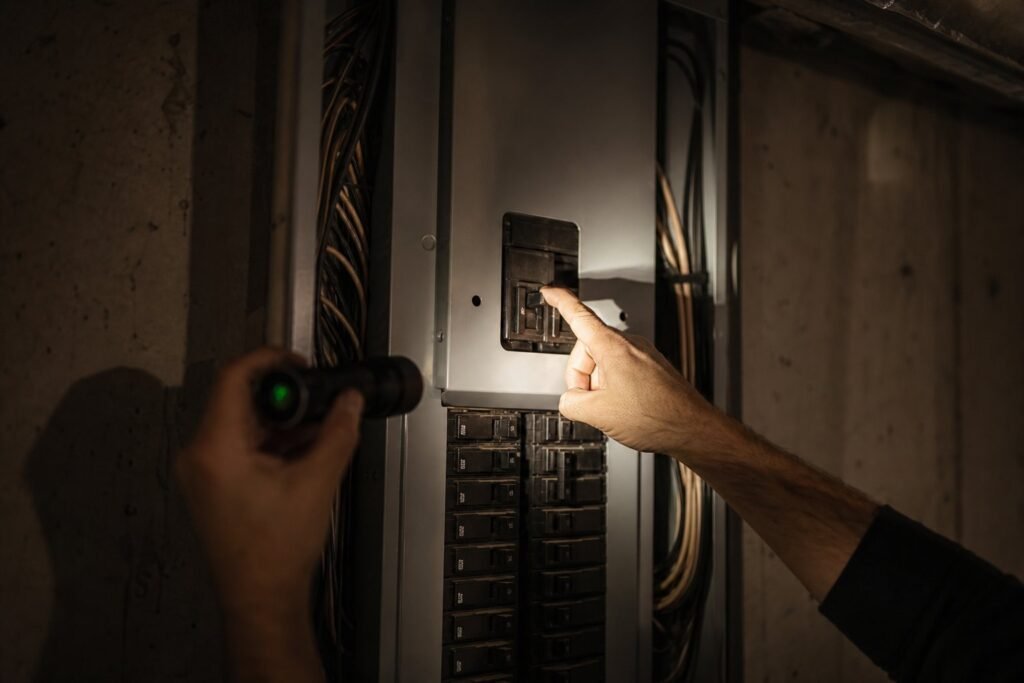
In an electrical emergency, the first five minutes follow one spine: cut power at the breaker, or the main, if you can reach it without touching anything hot, wet, or smoking; never put water on an electrical fire; get out and call 911 the moment you see flame or heavy smoke. Downed lines outside are 911 and Rocky Mountain Power, never an electrician. Everything inside the meter that’s hot, arcing, or burning-smelling gets an emergency electrician the same day.
In this guide
Which situations are true electrical emergencies?
Six scenarios inside the house justify emergency response, and they share one trait: energy is escaping its path as heat, arc, or shock right now. Learn these six and you’ll never have to wonder at 10pm.
- A burning smell you can’t explain, fishy, hot plastic, or acrid, near an outlet, switch, fixture, or the panel. Overheating insulation announces itself by smell before flame. We cover this one minute-by-minute in our burning-smell answer post.
- An outlet or switch that sparked beyond the faint blue blink of unplugging something, especially with scorch marks, sound, or smell.
- A panel that’s hot, buzzing, or sizzling. Panels should be silent and room-temperature. Heat or noise means a connection failing under the highest current in the house.
- Someone shocked by an appliance or fixture. The appliance is faulted and its metal may still be live. A tingle counts; it means the fault path runs through people.
- Water reaching live electrical equipment: a flooded basement with outlets under water, a leak running into a fixture or the panel.
- A downed or sagging power line. The one entry on this list that is never an electrician call: stay back, keep everyone back, call 911, then Rocky Mountain Power.
What do you do in the first five minutes?
One spine, three variations. Cutting power is always the goal; the variations exist because reaching the breaker isn’t always safe.
Burning smell, sparking, or a hot panel
- Turn off the breaker feeding the problem area. If you can’t identify it, or the panel itself is the problem and is hot or arcing, use the main breaker if the panel face is safe to approach, and only the outside face; never remove any cover.
- Leave plugged-in equipment alone until the circuit is dead and the device is cool. Pulling a plug mid-arc puts your hand at the fault.
- Open windows for smell, keep a working phone on you, and station someone where they can watch the area.
- See flame or heavy smoke, or the smell keeps intensifying with the breaker off? Evacuate and call 911. Fires inside walls outrun occupants who wait to confirm them.
- No flame and the situation is stable? Call an emergency electrician now, and leave the breaker off until the fault is found.
Shock or water contact
- If someone is being shocked and can’t let go, don’t touch them. Kill the breaker or main first, or separate them using something dry and non-conductive. Then call 911 for any shock beyond a brief tingle.
- For water near live equipment, cut power to the area only if the panel is somewhere dry and you can stand on dry ground to reach it.
- Never enter standing water in a room with outlets, cords, or appliances in it until the power is confirmed off. Water depth is irrelevant; an inch conducts.
- Once power is off, mark the appliance or area and keep it out of service until it’s inspected.
Downed line or damaged service drop
- Stay well back, at least a bus length, and assume the line and everything it touches is live: fences, puddles, the car it fell on.
- Call 911, then Rocky Mountain Power. Line repair is theirs alone; no electrician can touch it.
- If a line falls on your car while you’re in it, stay inside and wait for utility crews unless fire forces you out.
- Once the utility restores service, have the house side checked; surges and a torn service mast are electrician work.
Cutting the breaker costs you nothing; every other mistake in an electrical emergency costs more.
What should you never do?
Most electrical-emergency injuries come from a small set of instinctive reactions. These are the ones to unlearn in advance.
- Never put water on an electrical fire. Water conducts; you can be shocked through the stream, and the fire spreads. Use a Class C or ABC extinguisher, or leave and let the fire department earn their budget.
- Never keep resetting a breaker that re-trips. Each reset feeds the fault another surge of current. One reset is a test; a second trip is an answer.
- Never remove a panel cover or outlet plate to investigate, even with the main off. Service lugs stay live no matter what you switch.
- Never grab a person being shocked with bare hands; the circuit will happily add you.
- Never assume a faded smell means a fixed fault. The damaged connection is still there, one heat cycle from resuming.
Do this today: open your panel door and read the labels. Knowing which breaker owns the kitchen, and where the main is, turns a panicked minute into a ten-second fix. If the labels are missing or wrong, that’s a cheap thing to fix on any service visit.
Who do you call: 911, the utility, or an electrician?
Three phone numbers, three jurisdictions. The split is simpler than it feels at midnight.
| Situation | Call | Why |
|---|---|---|
| Flames, heavy smoke, anyone injured or badly shocked | 911 | Life safety outranks diagnosis; electrical fires move inside walls |
| Downed or sagging line, damaged pole, tree in the lines | 911, then Rocky Mountain Power | Live utility equipment; only line crews may touch it |
| Whole neighborhood dark | Rocky Mountain Power | Grid-side outage; nothing in your house caused it |
| Burning smell, sparking device, hot or buzzing panel, no flame | Emergency electrician | Active fault inside your system, contained for now |
| Half the house out, or power lost only at your home | Electrician or utility; either can rule their side out | Lost service leg sits near the meter, on either side of it |
| One dead outlet, a single flickering light | Regular appointment | A defect, not an emergency; scheduling it saves the after-hours premium |
What does same-day emergency response actually look like?
When you call us with an active fault, the first minutes happen on the phone: we confirm the breaker is off, walk you through anything unsafe, and decide together whether this is an electrician problem or a 911 problem. Same-day emergency help is available across Weber, Davis, Morgan, Box Elder, and Cache counties, and we’ll give you a realistic arrival window on that call rather than a comforting guess.
On site, emergency work has one goal: make the house safe tonight. That means locating the fault, isolating or repairing the failed connection or device, and being straight about what can wait. Not everything needs fixing at emergency rates; if the burned receptacle is replaced and the rest is routine, we’ll say so and price the follow-up as a normal emergency-to-repair handoff. The diagnostic method behind that triage is the same one laid out in our home electrical problems guide.
What isn’t an emergency, honestly?
After-hours rates are real money, and plenty of scary-feeling symptoms are safe to sleep on with the circuit off. A breaker that tripped once and held on reset. A dead outlet with no heat, smell, or sound. A GFCI that won’t reset in the bathroom, killing that outlet and nothing else. Flickering lights confined to one fixture or one circuit, with no warmth and no burning smell. All of those deserve diagnosis, none of them deserve a midnight premium, and turning the affected breaker off buys you a calm night in every case.
The line back to emergency territory is sensory: heat, smell, sound, or spread. Any of those four arrives and you’re back at the top of this page. Our diagnostic guide walks the non-urgent versions of these symptoms at daylight pace.
Quick answers
Should I unplug things during an electrical emergency?
Only after the circuit is off and the device is cool. Pulling a plug from an arcing or overheating receptacle puts your hand centimeters from the fault at its worst moment. Kill the breaker first; the plug can wait. The exception is a smoking appliance on a clearly healthy outlet, where unplugging it by the plug body is reasonable.
Is it safe to shut off the main breaker?
Yes, if the panel face is cool, dry, and quiet, flipping the main is exactly what it’s for. Stand to the side, look away as you flip it, and use one hand. If the panel is hot, buzzing, wet, or smells burnt, don’t touch it; leave the house and make the calls from outside.
My breaker trips the instant I reset it. Emergency?
It’s protection doing its job against a hard fault, likely a short in a device or the wiring. Leave it off and everything on that circuit unplugged, and it converts from emergency to urgent appointment. It becomes an emergency again if you smell burning, hear buzzing, or the breaker itself is hot.
Who pays if the problem is on the utility side?
Rocky Mountain Power maintains and repairs their equipment, the lines, the drop to your weatherhead, and the meter itself, at no charge to you. The weatherhead, mast, meter base, and everything into the house is the homeowner’s, which is where an electrician comes in. When it’s ambiguous, either party can identify whose side the fault is on.
Do I need an inspection after an electrical fire, even a small one?
Yes. Any fault that produced flame or char has likely damaged conductors beyond the visible spot, and insurance carriers generally expect a licensed assessment before the circuit returns to service. The inspection is small compared to re-energizing a compromised circuit inside a wall.
Something hot, burning, or sparking right now? Turn the breaker off first. Then call us and we’ll triage it on the phone, honestly, including whether it can wait until morning rates.
We run emergency calls throughout the four-county area, and our Riverdale electrician page covers response in Riverdale and the neighboring stretch of Weber County.