
Ceiling Fan Installation: Boxes, Braces, Switches, and High Ceilings
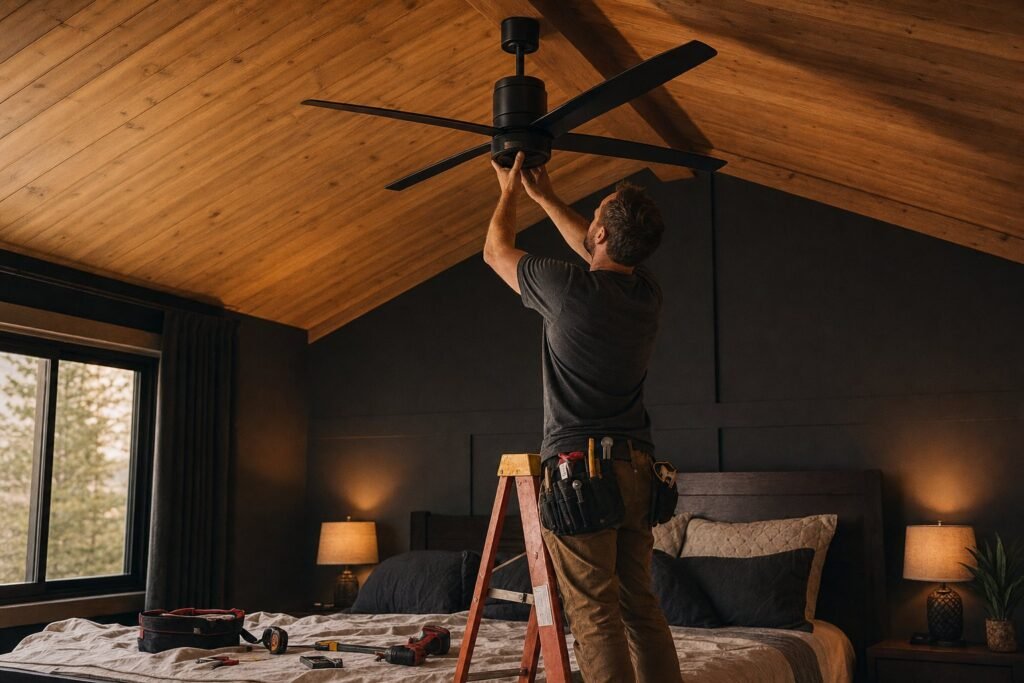
Ceiling fan installation has one non-negotiable at its center: the fan must hang from a box listed for fan support, because a standard light box isn’t rated for 15–50 pounds of spinning machine. Around that sit the real decisions, whether fan and light get separate switches, whether a remote replaces new wiring, what downrod a vaulted ceiling needs, and occasionally whether the circuit itself has room. Most installs onto an existing fan-rated box take an electrician about an hour ; box retrofits and new switch legs are where the job grows.
In this guide
Why can’t a fan hang from a regular light box?
Because the box was never asked to hold a machine. A standard ceiling box is rated for the static weight of a light fixture; a fan adds mass, torque on startup, and years of vibration that work fasteners loose. Code answers this directly: fans must be supported by boxes listed for fan support, marked accordingly, with standard listings good to 70 pounds and anything heavier hung independent of the box. No such marking, no fan.
This is the most common shortcut we find in homes across the Wasatch Front: a fan spinning politely from a plastic light box, held by two machine screws into material that was never tested for the job. It usually announces itself first as wobble, then as a fan that sags from the ceiling with a halo of cracked paint. If you didn’t install the fan and don’t know what’s above it, checking is a five-minute job with the canopy dropped, and it’s worth doing before the fan does the checking for you.
A light fixture hangs; a ceiling fan works for a living, and its box has to be hired for that job.
How do you retrofit a fan-rated box without opening the ceiling?
From below, in most framed ceilings, with a retrofit fan brace. The old box comes out through its own hole, and an expanding steel brace bar slips into the cavity, rotates to bite its teeth into the joists on either side, and carries a listed fan box clamped to its center. Done properly, the drywall is untouched except for the original opening.
- Kill the circuit at the breaker and confirm dead at the old box with a tester.
- Remove the old box, cutting its nails free or unscrewing it from the joist through the existing opening.
- Slide the brace bar into the cavity, center it over the opening, and rotate to expand it until it locks solidly between joists.
- Mount the listed fan box to the brace, land the existing cable in it, and torque everything to spec.
- Hang the mounting bracket, motor, canopy, and blades, then test on all speeds before calling it done.
Where the fixture location sits directly beside a joist, screwing a listed pancake fan box straight into the wood is often simpler than a brace. Attic access makes everything easier still, since a new box or a between-joist block can be installed from above. The brace hardware itself is modest money; the value is in knowing which method the framing above your specific ceiling wants .
How does the switch wiring work for a fan with a light?
Everything depends on how many switched conductors reach the box. One switched hot means the wall controls fan and light together as a unit, and pull chains or a remote handle the rest. Two switched hots, the classic three-conductor run to two wall switches, give the fan and light fully independent wall control, which is what most people actually want in a bedroom or family room.
Retrofitting that second conductor is called adding a switch leg, and it’s honest fishing work: new cable from the switch location up the wall and across to the fan box, difficulty set entirely by what’s above and inside the wall. In a single-story room under an attic it’s routine; in a two-story great room wall it can be the largest line on the quote. This is also the moment to fix related sins, ungrounded switch boxes, painted-over receptacles gone loose, since the wall is already being worked; our complete lighting upgrade guide makes the case for batching exactly this kind of work.
Should you choose a remote or a wall control?
A remote kit is the no-rewiring answer to independent control: a receiver tucks into the fan canopy, and a handheld or wall-mounted remote runs fan speed and light dimming separately over one existing switched hot. For rooms where adding a switch leg means fishing a two-story wall, it turns a half-day of wiring into a half-hour of setup, and modern receivers are dramatically more reliable than the flaky units of fifteen years ago.
Hardwired wall controls still win on permanence: nothing to lose in the couch, no receiver electronics to fail inside a hot canopy, and no pairing quirks when the power blinks, which canyon-wind season makes a real consideration along the benches. Many households land on the hybrid: proper two-switch wiring where walls make it affordable, remote kits where they don’t. One caution either way: standard dimmers must never control a fan motor, and a buzzing fan on a dimmed circuit is a miswire, not a preference .
Good to know: If your fan has a remote and misbehaves, flickers its light, changes speed on its own, ignores commands, try fresh remote batteries and re-pairing before assuming an electrical fault. Receiver quirks imitate wiring problems convincingly.
What do high and vaulted ceilings change?
Two things: geometry and access. A fan works by moving air across people, so on tall ceilings it must come down to where the people are, which is the downrod’s job. The blades also need at least 7 feet of clearance above the floor and roughly 18 inches from walls or a sloped ceiling plane, and steep vaults need a sloped-ceiling adapter so the downrod can hang plumb.
| Ceiling height | Typical downrod | Notes |
|---|---|---|
| 8 ft | Flush or stock 3–6 in. | Low-profile hugger fans where clearance is tight |
| 9 ft | 6–12 in. | The comfortable default in newer two-story homes |
| 10–12 ft | 12–24 in. | Bring the blades to 8–9 ft above the floor |
| 13–15 ft (vaulted) | 36–60 in. | Sloped-ceiling mount; scaffold or tall ladder work |
| 16 ft and up | 60–72 in. | Staging becomes part of the quote |
Access is the honest cost driver here. A great-room fan at 16 feet needs staging or scaffold, two people, and careful handling of a long downrod assembly, which is why the same fan costs more to hang in a vault than in a bedroom. It’s also why brace-retrofit work on a vault, with no attic above the slope, is planned carefully up front rather than discovered mid-job.
Why does a ceiling fan wobble, and can it be fixed?
Wobble is almost always one of four things, in this order: blades out of balance, blade holders bent or loose, canopy or bracket hardware loose, or the box and its support moving. The first three are maintenance, a balancing kit with clip-on weights, a screwdriver pass over every fastener, ten minutes of patience. The fourth is structural and is the one that matters, because a moving box means the fan’s anchor is failing.
The test is simple: with the power off, grab the (stationary) blades near the hub and push up gently. Fan movement is fine; ceiling movement, flexing drywall, a shifting canopy, is a support problem, and the fix is the fan-rated box conversation above, not more clip weights. A fan that hums, runs slow on all speeds, or trips the breaker has crossed from installation questions into diagnosis; that’s ceiling fan repair territory, and flickering fan lights specifically have their own short triage in our post on why LED lights flicker.
When does a ceiling fan need a new circuit?
Rarely for the fan itself: a typical fan motor with an LED light kit draws about as much as one bright old bulb did, so replacing a fixture with a fan adds trivial load to an existing lighting circuit. The new-circuit conversation shows up in three real cases: a room with no ceiling wiring at all, where a switch, cable, and box all have to be created; garages and shops where a heavy-duty or high-volume fan joins circuits already working hard; and additions or bonus rooms where the nearest lighting circuit is already dense with fixtures and the panel has better options.
New circuits and new wiring runs bring permits and inspection with them in most Utah cities , which is protective, not bureaucratic: it means the fished cable and new connections get a second set of eyes. If a fan project is turning into a wiring project, our lighting upgrade guide shows how to fold it into a larger plan, jobs like the layouts in our recessed lighting post often ride along in the same visit, and our lighting installation service quotes it all as one scope.
Quick answers
How long does ceiling fan installation take?
Onto an existing fan-rated box with existing switching: about an hour, including assembly and testing . Add a brace retrofit and it’s a half-day visit; add a new switch leg or a vaulted ceiling and it can fill a day. The variable is never the fan, it’s the box, the walls, and the height.
How much does it cost to install a ceiling fan?
Typical market range is $150–$350 onto an existing fan-rated box, and $300–$600 or more when a brace retrofit, new switch leg, or tall-ceiling staging joins the job . The fan itself is separate. Batching a fan with other lighting work in one visit lowers the effective price of both; see our ceiling fan installation and repair page for how we quote it.
Can I install a ceiling fan where a light fixture is now?
Usually yes, and it’s the most common fan job there is. The two questions are whether the box is fan-rated (often it isn’t, which a retrofit brace solves without opening the ceiling) and whether you want fan and light switched separately (a remote kit or a new switch leg answers that). The existing circuit almost always has capacity for the fan.
Do bigger rooms need bigger fans?
Yes, and undersizing is the common mistake. As rough guidance, rooms up to about 75 square feet suit 29–36 inch fans, typical bedrooms 42–48 inches, and family rooms and masters 52–60 inches . A properly sized fan on medium speed beats a small fan straining on high, in both noise and air moved.
Which direction should a ceiling fan spin in winter?
Reverse (clockwise, viewed from below) on low speed in winter, pulling air up to push the warm ceiling layer down the walls without a draft. Counterclockwise in summer for direct breeze. In Utah’s heating-dominated climate the winter setting is the one people forget, and it meaningfully evens out rooms with tall ceilings.
Fan sitting in its box, or an old one wobbling overhead? We’ll confirm the support, sort the switching, and hang it right the first time.
We hang and repair fans across Davis County regularly, including Bountiful’s east-bench homes, where vaulted great rooms and long downrods are practically the local specialty. How we work there is on our Bountiful electrician page.