
100A vs 200A: How Much Service Your Home Actually Needs
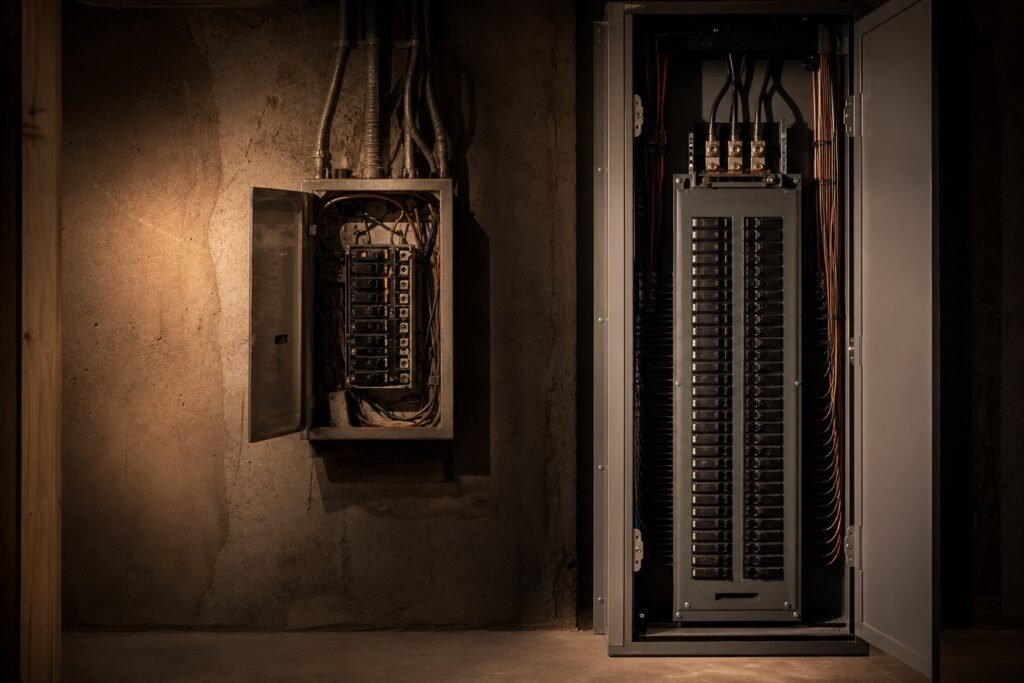
For most Utah homes, the difference comes down to headroom: 100-amp service was the standard when much of the Wasatch Front was built and still handles a home with gas appliances and modest loads, while 200-amp service is the modern standard with room for an EV charger, a hot tub, central air, and electric appliances together. If your panel is full or your plans include any large new load, 200 amps is usually the right call.
In this guide
What do 100 amps and 200 amps actually mean?
Your electrical service size is the maximum current your home can draw from the grid at once, set by the service entrance equipment and the main breaker in your panel. Think of it as the width of the pipe, not the amount of water you use: a bigger service doesn’t raise your bill, it raises the ceiling on what can run at the same time.
One hundred amps at 240 volts works out to roughly 24,000 watts of theoretical capacity; two hundred amps doubles that. In practice, code sizing calculations keep real usage below those ceilings, which is exactly why a “full” 100-amp panel is common in homes that added loads across the decades: the ceiling didn’t move while the household did.
Everything modern life plugs in was invented after your panel was.
How do I check what service my home has now?
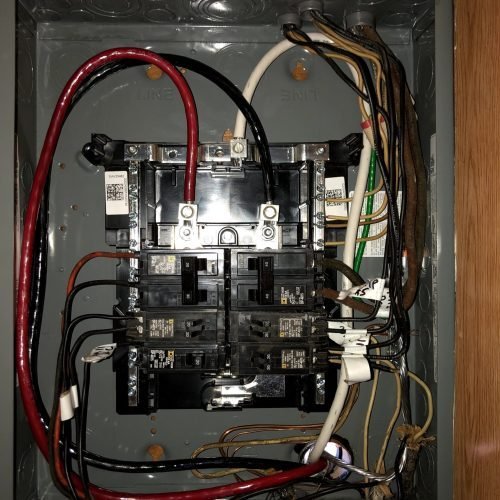
The fastest reliable check takes about two minutes at your panel:
- Open the panel door (just the door, never the inner cover) and find the main breaker, usually the large breaker at the top.
- Read the number stamped on its handle: 100, 125, 150, or 200. That number is your service size in amps.
- No main breaker visible, a fuse block instead, or a panel marked 60? You’re looking at an earlier era of service, and an evaluation is worth scheduling on its own merits.
- Cross-check against reality: if the panel is crowded with tandem breakers or has no empty slots, the label and the lived truth may differ.
Good to knowThe number on the main breaker is the answer; the sticker inside the door and the size of the box can both mislead. When in doubt, a licensed electrician can confirm service size and true available capacity in one short visit.
How much power does a modern home actually draw?
The loads below are typical ranges for common household equipment. Exact numbers vary by model, which is why real upgrade decisions start with a load calculation rather than a guess:
| Load | Typical circuit | Notes |
|---|---|---|
| Central air conditioning | 20–40A / 240V | The classic summer capacity-eater |
| Electric range or oven | 40–50A / 240V | Gas ranges sidestep this entirely |
| Electric dryer | 30A / 240V | Gas dryers draw a fraction |
| Level 2 EV charger | 20–60A / 240V | Sized to the vehicle and panel; see below |
| Hot tub | 50A / 240V | Plus GFCI protection and a disconnect |
| Electric furnace or heat pump strips | 40–60A+ / 240V | The largest residential loads going |
| Everything 120V (lights, plugs, kitchen) | 15–20A each | Death by a dozen small circuits |
Stack a Utah winter evening together, heat, dryer, oven, EV topping up in the garage, and a 100-amp ceiling stops being theoretical. That stacking effect, not any single appliance, is what pushes homes over the line.
100A vs 200A, side by side
| 100-amp service | 200-amp service | |
|---|---|---|
| Era | The standard for most homes built before the 1990s along the Wasatch Front | The modern default in new construction |
| Comfortably runs | Gas-appliance homes with modest electrical loads | Full-electric living with multiple large loads at once |
| EV charging | Often requires load management or an upgrade first | A dedicated Level 2 circuit usually fits with room to spare |
| Hot tub or major addition | Frequently at or past the limit | Headroom by design |
| At resale | Increasingly flagged by inspectors and buyers | A non-issue that quietly helps |
| Upgrade cost | Baseline | Commonly $1,500–$3,000 in Utah for 100→200A |
Why this question comes up so often along the Wasatch Front
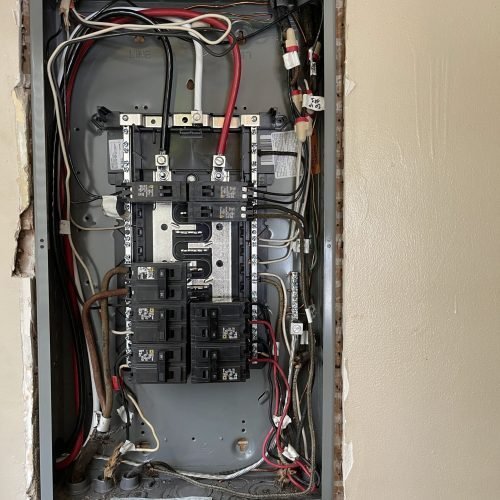
Northern Utah’s housing stock makes the 100-versus-200 question a local staple. The corridor built out in waves, and each wave wired to its era’s assumptions:
| Housing era | Typical original service | What usually forces the question |
|---|---|---|
| Pre-war Ogden & older cores | 60A, fuses common | Any modern load; often flagged at sale |
| Post-war boom (Roy, Clearfield, Layton cores) | 100A | EVs, central air, finished basements |
| 1970s–90s benches & suburbs | 100–150A | Hot tubs, additions, panel age itself |
| 2000s to new construction | 200A standard | Rarely the service; usually just slot space |
Layer on Utah realities, winter space-heater season, canyon-wind outages that argue for generator transfer equipment, and one of the country’s fast-growing EV markets, and older services meet demands their builders never priced in. The pattern is so consistent that we can often predict a home’s service size from its street and decade before the panel door opens.
Signs your 100-amp service is at its limit
- Breakers trip when big loads overlap: the microwave-plus-space-heater blackout is capacity talking.
- Lights dim when the furnace or AC kicks on: motor start-ups are borrowing from everything else.
- The panel is physically full: no empty slots and tandem breakers stacked in means new circuits have nowhere to land.
- You’re planning any large addition: EV charger, spa, basement kitchen, or a heat pump conversion all start with a capacity question.
- The equipment itself is aging out: a 60-year-old panel at 100 amps usually has two reasons to go, not one.
Two or more of those signs and it’s worth a professional read. Our panel and meter upgrade service starts with exactly that evaluation, and the quote comes before any work does.
When 100 amps is still enough
Honesty matters more than upsells: plenty of Utah homes are fine at 100 amps. If your heat and water heater are gas, your cooking is gas, there’s no EV or hot tub on the horizon, and the panel itself is healthy with breathing room, upgrading buys you little beyond resale polish.
The right move in that case is maintenance, not replacement: keep the panel’s connections sound, its protection current, and revisit the math only when your plans change. An electrician who tells you not to spend money is one worth keeping.
What upgrading to 200 amps involves in Utah
A service upgrade is permitted, inspected work everywhere on the Wasatch Front, and it touches equipment only the utility can disconnect. The honest sequence:
- A load calculation confirms the right size and surfaces anything else the service entrance needs.
- A permit is filed with your city; this protects you at inspection and resale.
- Rocky Mountain Power (or your municipal utility in cities like Bountiful and Kaysville) schedules the disconnect and reconnect.
- On install day, the old equipment comes out, the new panel and any meter-base work go in, and most homes are re-energized the same day.
- The city inspection closes the permit, and every circuit leaves labeled.
The full walkthrough, including what moves the price, lives on our panel upgrade page. If the upgrade is happening ahead of an EV charger or a hot tub circuit, bundling them saves a permit cycle and a second visit.
Quick answers
Can I add a subpanel instead of upgrading?
A subpanel redistributes capacity you already have; it doesn’t create more. If your 100-amp service has genuine headroom and the problem is slot space, a subpanel can be the right, cheaper fix. If the service itself is the bottleneck, only an upgrade moves the ceiling. A load calculation tells you which story is yours.
Will 200-amp service raise my power bill?
No. Service size is capacity, not consumption; you’re billed for the energy you use, not the size of the pipe delivering it. A bigger panel changes what can run simultaneously, nothing about the meter’s math.
Do I need 200 amps for an EV charger?
Not automatically. Some 100-amp homes carry a modest Level 2 circuit after a load calculation, sometimes with a load-management device. Many need the upgrade first. The honest answer is arithmetic, and it’s exactly what we check before quoting any charger install.
How long does a 100-to-200-amp upgrade take?
Most are completed in about one day on site once the permit and utility scheduling are in place, with power off for part of that day. Mast or meter-base complications can extend it, and you’ll know the realistic window before work starts.
Not sure which side of the line your home sits on? One visit answers it, with a straight quote and zero pressure.
Based in Ogden and read something here that applies to your house? Our Ogden electrician page covers how we work in the city’s housing stock specifically.