
Can My Electrical Panel Handle an EV Charger?
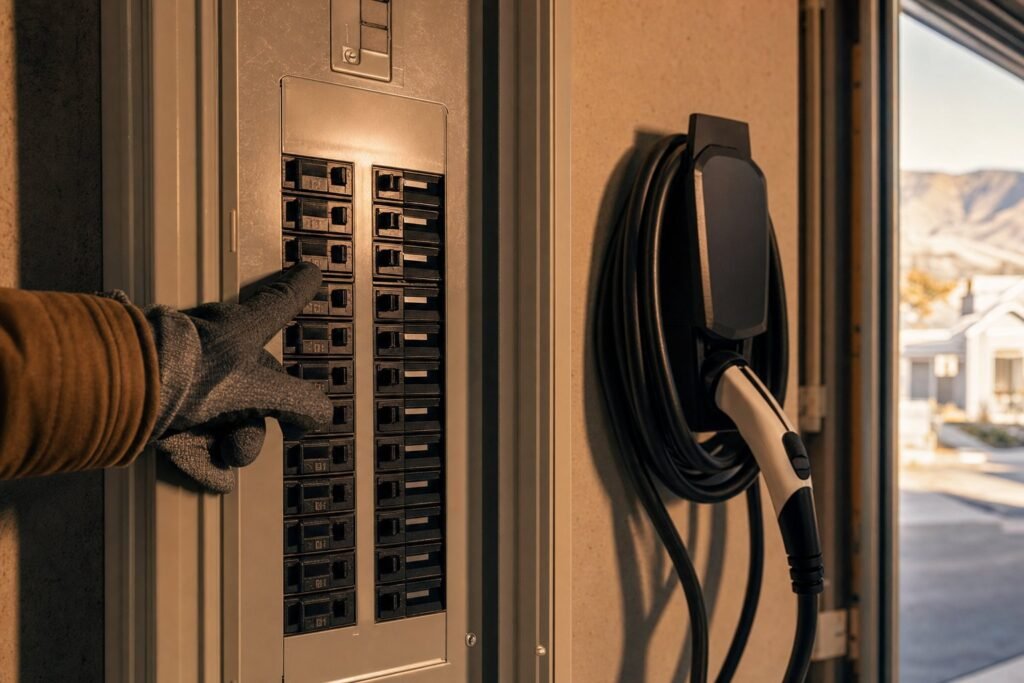
It depends on your panel’s calculated spare capacity, not its empty slots. An NEC load calculation tallies your service size against existing loads, with the charger counted at 125 percent of its output. Many 100-amp Utah homes pass for a modest Level 2 charger; some need a load-management device or a service upgrade instead. A load calculation settles it definitively.
In this guide
Why don’t empty breaker slots answer the question?
Because slots measure space, and the question is about supply. Every circuit in the box shares the service rating on the main breaker; open slots just mean a new breaker has somewhere to sit. A charger is different from anything else you’ve added: it draws hard for hours at a stretch, so the code counts it at 125 percent of its output against your service. A 32-amp charger books 40 amps of your capacity, every evening, right when dinner and laundry are also on the clock.
The flip side is better news: a physically full panel doesn’t mean no. If the arithmetic shows headroom, tandem breakers or a small subpanel create the space cheaply. Space problems are cheap; supply problems are the real fork in the road.
What can you check yourself in two minutes?
- Open the panel door (only the door) and read the number on the main breaker: 100, 125, 150, or 200. That’s your service size.
- Count your gas appliances: furnace, water heater, range, dryer. Every gas appliance is electrical capacity you’re not using.
- Note the big 240-volt loads already present: AC, electric heat, hot tub, shop equipment. These are the charger’s competition.
- Recall your winter evenings: dimming lights or a main breaker that has ever tripped under load are capacity talking.
Rough scoring: 200 amps with gas appliances almost always passes. 100 amps with gas heat and water is a genuine maybe, and often a yes for a mid-size charger. 100 amps all-electric is a hard fit that usually needs load management or an upgrade. The self-check predicts the answer; the load calculation in our panel capacity explainer is what the permit rides on.
What does the electrician actually verify?
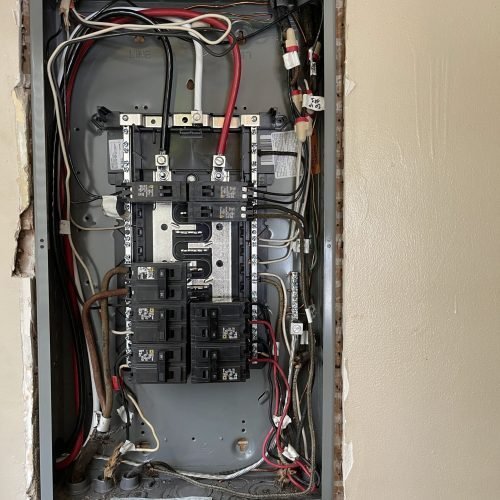
Three things the door sticker can’t tell you. First, the real calculation: square footage, fixed appliances, and demand factors, done to code method rather than gut feel. Second, the panel’s condition and pedigree: a 1960s service at its ceiling, aluminum branch wiring from the 1970s, or a recalled panel brand changes the plan regardless of the math. Third, the practical route: where the circuit lands, what the wire run looks like, and which amperage tier leaves honest margin.
That last part matters because the tier is adjustable. If 48 amps doesn’t fit, 32 usually behaves very differently in the math, and the overnight difference is minor; the trade-offs are laid out in our Level 1 vs Level 2 charge-time math. A good evaluation ends with the largest tier that fits comfortably, not the largest tier that fits on paper.
The right question isn’t whether a charger fits. It’s which charger fits with margin to spare.
What are the three possible outcomes?
| Outcome | What it means | Typical added cost |
|---|---|---|
| Fits as-is | The calc passes with margin; a standard circuit install proceeds | None beyond the install |
| Fits with load management | A listed device pauses charging when the house is busy, satisfying the math | Several hundred dollars in hardware |
| Needs a service upgrade | Committed load leaves no honest room; 200A service solves it and future loads | $1,500–$3,000 for 100→200A in Utah |
Most homes we evaluate land in the first two rows, where the fix rides along with a standard EV charger installation. When the third row is the honest answer, it deserves its own decision rather than a reflex: our panel and meter upgrade service prices it alongside the charger work, and bundling both into one permit cycle costs meaningfully less than sequencing them a year apart. The complete EV charger installation guide shows how the capacity answer shapes everything downstream.
Good to know: load management isn’t a workaround; it’s a code-recognized method. The device caps combined demand by design, the car still fills overnight, and the panel never sees the stacked peak the static math worries about.
When the answer is: don’t add the load
Sometimes the honest outcome is that no Level 2 circuit should go in at all, and it has nothing to do with the panel. If your daily miles are short, a plug-in hybrid is doing the driving, or the car regularly charges at work, the Level 1 cordset on a healthy outlet covers you at zero cost, and the entire capacity question evaporates: a 12-amp trickle barely registers in any load calculation.
We say this in driveways regularly: don’t buy capacity for a load you don’t have. Run your real weekly mileage first, and if Level 1 already covers it, bank the money until your driving changes. The panel will still be there when it does.
Quick answers
Can a 100-amp panel really support a Level 2 charger?
Often, yes. A 100-amp home with gas heat, water, and cooking frequently calculates clean for a 16-to-32-amp charger, which still charges several times faster than a wall outlet. All-electric 100-amp homes are the hard cases. The main breaker number alone never decides it; the committed load does.
What does a load calculation cost?
It’s typically folded into the evaluation visit rather than billed as a separate line; Utah service calls broadly run $75–$150. Ours comes with a written quote for the install paths it reveals, so the visit produces decisions, not just a number.
My panel is completely full. Is that a dealbreaker?
No, it’s usually the cheap problem. If the calculation shows spare service capacity, tandem breakers or a compact subpanel create the physical space for the new circuit at modest cost. The dealbreaker question is calculated capacity, and a full panel says nothing about that either way.
Will charging at night get around a tight panel?
Scheduling helps reality but not the permit: the code math assumes loads can coincide, so a calculation that fails at dinnertime fails at midnight too. A load-management device is the legitimate version of this instinct; it enforces the timing automatically and satisfies the code, where a habit can’t.
Read your main breaker, count your gas appliances, and call us with both. We can usually tell you which outcome you’re facing on the phone, and confirm it with the real calculation in one visit.
Layton’s housing spans 1950s Hill-adjacent neighborhoods on original services to new 200-amp builds in the east benches, so this question rarely has one answer per street. Our Layton electrician page covers how we approach both eras.