
Does Your Panel Have Room for an EV Charger? Load Calculations Explained

Whether your panel has room for an EV charger is decided by a load calculation: an NEC-based tally of your service size against your home’s existing loads, with the charger counted at 125 percent of its output because it runs for hours at a time. Empty breaker slots prove nothing. Here’s how the math works, and the three paths forward when it comes up tight.
In this guide
What is a load calculation, actually?
A load calculation is the electrical code’s method for answering one question with arithmetic instead of vibes: can this service carry everything this house asks of it at once? It starts with square footage for general lighting and receptacles, adds the fixed appliances (range, dryer, water heater, HVAC), applies the code’s demand factors, which account for the fact that not everything runs simultaneously, and compares the total against your service rating.
The result is a number, and the number is the answer. If a 100-amp service calculates to 78 amps of demand, there’s honest room for a modest charger circuit. If it calculates to 96, there isn’t, no matter how empty the panel looks. This is the same math a city plan reviewer applies when the permit is filed, which is why guessing tends to get expensive at inspection time.
Every charger quote we write starts with this calculation, because it determines the entire shape of the project: the amperage tier, the hardware, and whether the panel itself needs attention first. The complete EV charger installation guide shows where this step sits in the full sequence.
Why counting breaker slots misleads
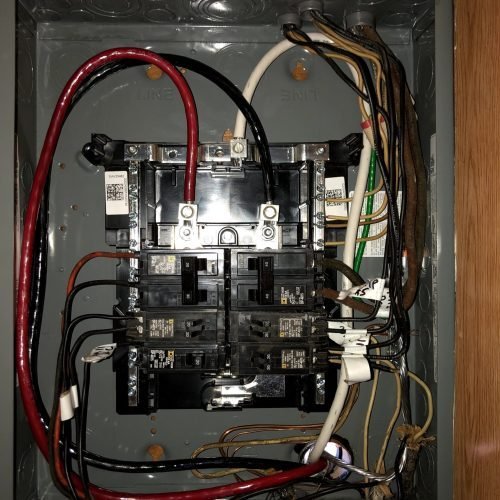
An empty slot means there’s a parking space for a breaker; it says nothing about whether the service can feed it. Service capacity lives at the main breaker, and it’s shared by every circuit in the box. A 100-amp panel with six open slots still delivers 100 amps total, and a full 200-amp panel with zero open slots may have 80 amps of calculated headroom just waiting for a tandem breaker or a small subpanel to give it a landing spot.
The two failure modes run in opposite directions. Homeowners with full panels assume they can’t have a charger when often they can, cheaply. Homeowners with open slots assume they can when sometimes they can’t, and that mistake shows up as a main breaker that trips on winter evenings when the heat, the dryer, and the car all stack up at once. Slots are a mechanical question; capacity is an arithmetic one.
An empty breaker slot is a parking space, not a power supply.
The 125 percent rule for EV circuits, in plain English
The electrical code treats any load that runs three hours or more as continuous, and it makes the circuit oversized by a quarter to handle the sustained heat. Almost nothing else in a house charges for six straight hours; an EV does it nightly. So a charger delivering 32 amps must sit on a circuit rated for 40, and the load calculation counts it at 40, not 32.
This is the quiet reason EV circuits strain panels more than their nameplate suggests, and it works like this at every tier:
| Charger delivers to car | Counts against your panel as | Breaker installed |
|---|---|---|
| 16A | 20A | 20A |
| 24A | 30A | 30A |
| 32A | 40A | 40A |
| 40A | 50A | 50A |
| 48A | 60A | 60A |
Notice what the table implies: dropping one tier, from 48 amps to 32, frees 20 amps of calculated capacity. On a borderline panel, that single hardware setting is frequently the difference between a simple install and a service upgrade, and the overnight charging difference is barely noticeable. The speed trade-offs by tier are covered in our Level 1 vs Level 2 charge-time math.
What are your options when capacity is tight?
A tight load calculation isn’t a dead end; it’s a fork with three honest paths, in rising order of cost:
- Size the charger down. A 16-or-24-amp unit fits panels a 48-amp unit never will, and still charges several times faster than Level 1. Adjustable units make this reversible after a future upgrade.
- Add load management. A listed device watches your service in real time and pauses or throttles charging when the house is busy, letting the code math work on a panel that’s otherwise full. Hardware typically adds several hundred dollars, far less than new service.
- Upgrade the service. When the house is heading toward more electrification anyway, 200-amp service solves the EV question and every question after it. Utah 100-to-200-amp upgrades commonly run $1,500–$3,000.
Which path wins depends on where the house is heading. A one-EV household with gas appliances often does best at option one or two; a home eyeing a hot tub, a heat pump, or a second EV usually shouldn’t pay for stopgaps. The upgrade decision has its own full treatment in 100-amp vs 200-amp service, and our panel and meter upgrade service quotes it alongside the charger so you can compare real numbers, not guesses.
Why Wasatch Front homes hit this wall so often
Northern Utah’s housing stock was built for a different electrical life. The post-war neighborhoods that fill Ogden, Roy, Clearfield, and Syracuse’s older sections went up with 60-to-100-amp services, sized for gas heat, gas water, and a house that owned one television. Those services have since absorbed decades of additions: central air, basement finishes, workshop circuits, hot tubs.
An EV charger frequently arrives as the largest single load the panel has ever been asked to carry, landing on a service that was near its practical ceiling already. That’s not a reason to skip the charger; it’s a reason to run the math first. In practice we find the full spread: 100-amp homes that pass comfortably, 200-amp homes with surprising amounts already committed, and everything between. The houses are too different for rules of thumb, which is exactly why the code uses arithmetic.
When panel capacity is a non-issue
Skip the worry, and the spending, in a few common situations. A home with 200-amp service, gas heat, and gas appliances almost always carries a full-size charger circuit without a second thought; the calculation takes minutes and passes with room to spare. Newer construction in Davis and Weber counties generally falls here.
And if your driving is light enough that Level 1 covers it, the whole capacity question dissolves: a 12-amp cordset on a healthy dedicated 120-volt circuit barely registers on any panel’s math. Nobody should buy a panel upgrade to support a commute that a wall outlet already handles. The honest test is your daily miles, not your neighbor’s hardware.
What does the on-site capacity check look like?
Fifteen to thirty minutes, typically, and it’s the foundation of an accurate quote:
- Read the service size from the main breaker and confirm the panel’s make, era, and condition.
- Inventory the major loads: heat source, water heater, range, dryer, AC, and anything 240-volt already in the box.
- Run the calculation and land on the highest charger tier the service carries with honest margin.
- Walk the wire route from panel to parking spot, since distance drives the labor side of the price.
- Put the whole thing in a written quote: tier, hardware, permit, inspection, and any capacity work priced as a separate line so the choice stays yours.
Good to know: the calculation is part of every EV charger installation we quote, not a separate engagement. If the math says your panel is fine, you’ll never hear a capacity upsell; if it says otherwise, you’ll see the numbers that say so.
If you want a preview before anyone visits, can my panel handle an EV charger walks the two-minute self-checks that predict the answer surprisingly well.
Quick answers
Can I do my own load calculation?
You can get a useful estimate. Add your major appliance loads and your service size into any reputable NEC load-calculation worksheet, and you’ll usually predict the professional answer. The permit still rides on a calculation done to code method, but a homeowner estimate is a great way to walk into a quote informed.
Does a 100-amp panel automatically rule out Level 2?
No. A 100-amp home with gas heat, gas water, and gas cooking frequently passes a load calculation for a 16-to-32-amp charger. What rules homes out is committed load, not the number on the main breaker; an all-electric 100-amp house is a much harder fit than a gas one.
What is a load-management device, exactly?
A listed controller that monitors your whole-home draw and throttles or pauses EV charging when the rest of the house is busy, resuming when load drops. Because it caps the combined demand by design, the code lets it satisfy the math a static calculation fails. The car still fills overnight; it just yields the right-of-way at dinnertime.
Will an EV charger overload my panel if the calc was done right?
That’s the point of doing it right: the calculation exists so the answer is no. The 125 percent continuous-load factor builds in sustained-heat margin, and the breaker protects the circuit beyond that. Panels get in trouble from unpermitted, uncalculated additions, not from engineered ones.
Should I just upgrade to 200 amps while I’m at it?
Only if the house is heading somewhere that needs it: second EV, heat pump, hot tub, big shop. Then bundling the upgrade with the charger saves a permit cycle and a second visit. If the charger fits your current service with real margin and no such plans exist, the upgrade is spending, not investing.
We’ll run the load calculation, tell you the largest charger your panel honestly carries, and price every path in writing, including the ones that cost less than you expected.
Syracuse’s housing runs the full spectrum, from 1970s panels near Antelope Drive to brand-new 200-amp construction west of Bluff, and the capacity answer changes block by block. Our Syracuse electrician page covers how we handle both ends of that range.