
Level 1 vs Level 2 EV Charging: Real Charge-Time Math
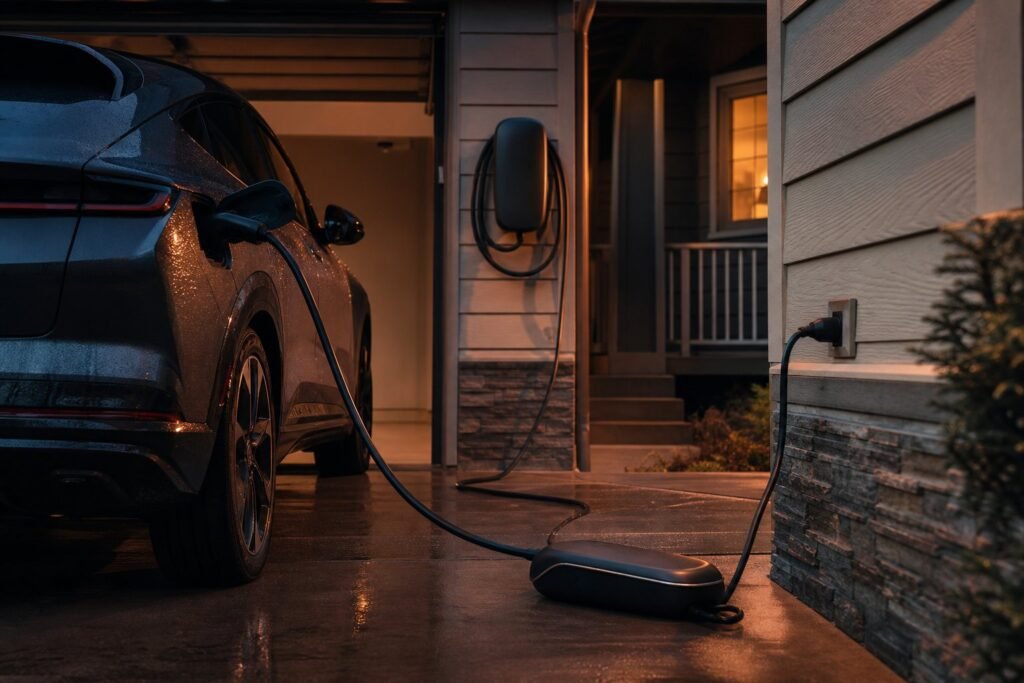
Level 1 charging uses an ordinary 120-volt outlet and typically adds 3–5 miles of range per hour. Level 2 uses a dedicated 240-volt circuit and typically adds 20–40+ miles per hour depending on amperage. Which one you need is arithmetic: your daily miles against your overnight hours. This post runs that math honestly, including the cases where Level 1 wins.
In this guide
What is Level 1 charging?
Level 1 is the charging cable that came in the trunk, plugged into a standard household outlet. It draws about 12 amps at 120 volts, roughly what a space heater pulls, and it converts that trickle into range slowly: a full night typically restores 30 to 50 miles. Nothing needs to be installed to start using it, which is both its whole appeal and its whole limitation.
The one real requirement is an outlet worthy of the job. Continuous 12-amp draw for ten hours will find every weak point in an old garage receptacle, so a Level 1 household should be charging from a dedicated circuit with a commercial-grade outlet, never through an extension cord or a receptacle shared with a freezer.
What is Level 2 charging?
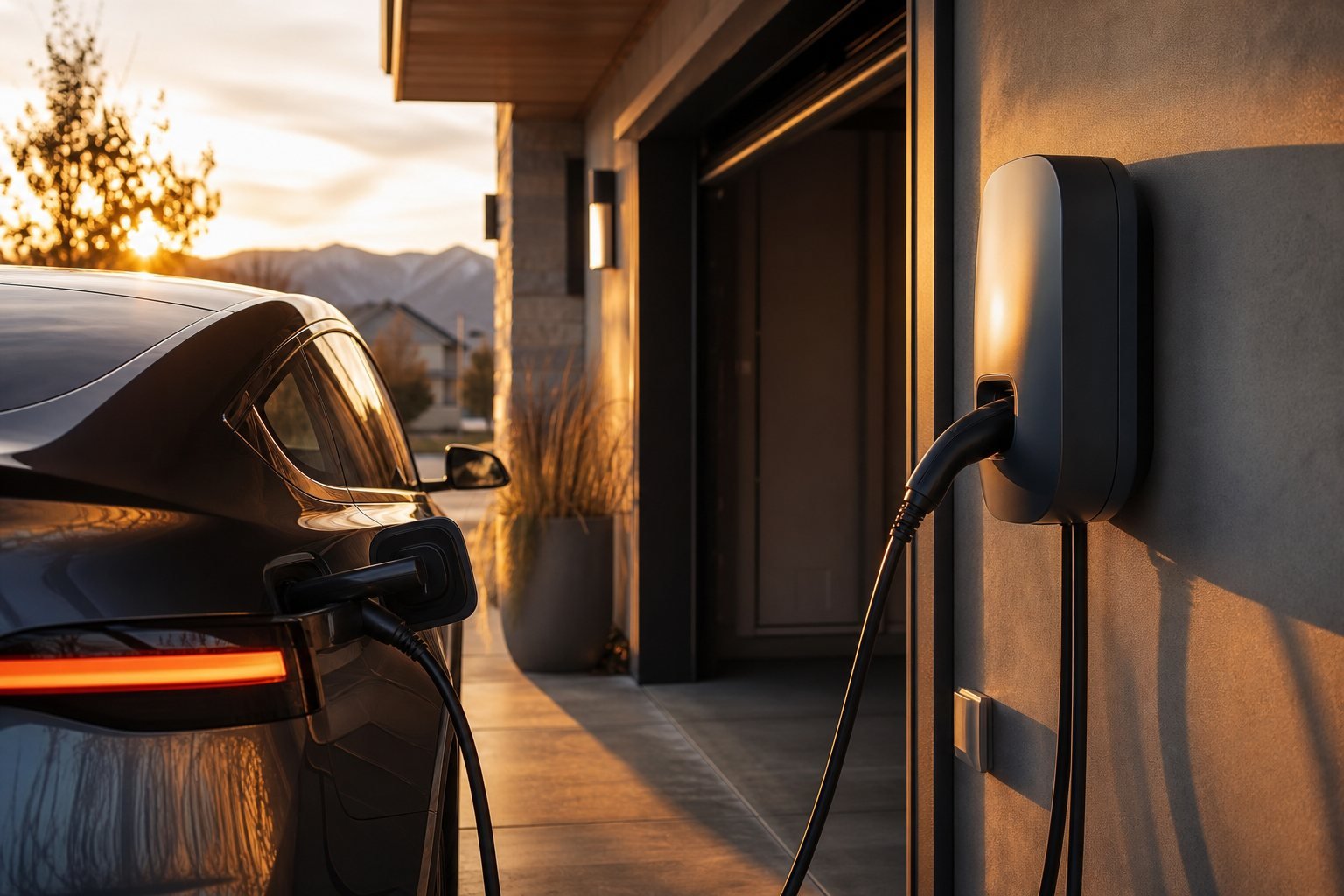
Level 2 is a 240-volt wall unit on its own dedicated circuit, the same class of supply that feeds a dryer or range, delivering anywhere from 16 to 48 amps to the car. That four-to-ten-fold jump in power is what turns charging from a planning exercise into a non-event: the car is simply full every morning.
The unit itself, often called an EVSE, is really a smart safety switch; the actual charger lives inside the car. What you’re buying with an installation is the circuit: a properly sized breaker, heavy-gauge wire to the parking spot, and either a hardwired connection or a heavy 240-volt receptacle. Our complete home EV charger guide covers the hardware decisions in detail.
The real math: miles of range per hour of charging
Charge speed scales with power, and power is volts times amps. Here’s how that lands in practice for a typical efficiency sedan or crossover; trucks and less efficient EVs gain fewer miles from the same energy:
| Setup | Power delivered | Range per hour | Overnight (10 hours) |
|---|---|---|---|
| Level 1, 12A @ 120V | About 1.4 kW | 3–5 miles | 30–50 miles |
| Level 2, 16A @ 240V | About 3.8 kW | 11–14 miles | 110–140 miles |
| Level 2, 32A @ 240V | About 7.7 kW | 22–28 miles | Full for nearly any commuter |
| Level 2, 48A @ 240V | About 11.5 kW | 34–42 miles | Full, usually by midnight |
Read the table against your actual life. A 40-mile round-trip commute needs about 10 hours of Level 1, or under two hours at mid-tier Level 2. The overnight column is the honest one: the question is never “how fast,” it’s “is the car full by morning,” and for most commutes even modest Level 2 answers yes with a large margin.
Two adjustments keep the math honest. Efficiency varies: a compact EV stretches each kilowatt-hour further than a three-row SUV, so the same amperage buys different miles in different driveways. And the last 20 percent of the battery charges slower by design, though for daily use that rarely matters, since most owners cap routine charging at 80 percent anyway.
Nobody needs the fastest charge. Everybody needs the car full by the time they leave.
Which amperage tier do you need, and what does each require?
Level 2 isn’t one speed; it’s a ladder, and each rung asks more of your panel. Because EV charging is a continuous load, the breaker must be rated 125 percent of the charger’s output:
- 16A (20A breaker): the gentlest Level 2, friendly to tight panels, and still triple Level 1 speed.
- 24A (30A breaker): a comfortable fit on many older services; covers commutes up to highway-warrior territory.
- 32A (40A breaker): the sweet spot for most households; overnight headroom for nearly any daily pattern.
- 40A (50A breaker): the top of what a plug-in unit on a NEMA 14-50 can deliver.
- 48A (60A breaker, hardwired only): meaningful mostly for big-battery trucks and two-EV households.
The right rung is the highest one your panel carries comfortably, not the highest one sold. Whether your service has that room is a load-calculation question; our panel capacity explainer shows how the math actually works.
Good to know: many quality wall units are adjustable across several of these tiers. Buying an adjustable unit and commissioning it at the amperage your panel supports today keeps a future upgrade to a breaker swap and a settings change, with no new hardware.
Who genuinely does fine on Level 1?
Plenty of drivers, and it costs nothing to find out, because you already own the equipment. Level 1 keeps up when the math works: roughly 40 miles restored per night covers a sub-40-mile daily pattern indefinitely. That describes a lot of real households:
- Short commuters: 10 to 25 miles a day never gets ahead of an overnight trickle.
- Plug-in hybrids: batteries in the 25-to-50-mile class refill completely on Level 1, every single night.
- Second cars and retiree schedules: errand-pattern driving with frequent full days at home.
- Drivers with workplace charging: arriving home at 80 percent makes home speed nearly irrelevant.
The honest caveat runs the other way too: Level 1 has no reserve. A heavy weekend, a skipped night, or a January cold snap digs a hole that takes days to refill at 4 miles an hour. If your mileage is spiky rather than steady, the buffer is what Level 2 is really buying you.
What does Utah winter change?
Cold is the strongest argument for Level 2 in this state. A cold-soaked battery accepts charge slowly and spends energy warming itself before it stores anything, so Level 1’s already-thin trickle loses a real fraction to battery conditioning on cold nights. The 40 miles you counted on can quietly become 25.
Level 2 shrugs at all of it. The charge finishes with hours to spare even after cold losses, and preconditioning, warming the battery and cabin before departure, runs off the wall instead of the pack. On a single-digit Ogden morning, that’s a warm car, a full battery, and full regenerative braking from the first stoplight, which Level 1 households simply don’t get.
What does moving up to Level 2 involve?
It’s a one-visit project for most homes:
- A load calculation confirms which amperage tier your panel carries safely.
- A quote fixes the price: circuit, unit (yours or ours), permit, and inspection.
- The install: breaker, wire run to the parking spot, hardwired unit or 240-volt receptacle, then a test charge on your car.
- The city inspection closes the permit and the paperwork stays with the house.
Typical installed cost in Utah runs $1,200–$3,200, driven mostly by wire-run distance and panel condition; the full breakdown is in our EV charger cost answer. Our EV charger installation service handles the whole sequence, and the complete guide covers placement, connectors, and hardware choices before you buy anything.
Quick answers
Is Level 2 charging bad for my battery?
No. Both Level 1 and Level 2 are gentle, slow charging from the battery’s perspective; the rates that stress a pack are DC fast-charging rates, many times higher. Home Level 2 with a sensible charge limit is about the kindest routine an EV battery can have.
Can I just use my existing dryer outlet?
Not by unplugging the dryer and sharing; an EV circuit generally needs to be dedicated. Code-listed load-sharing switches exist for exactly this situation and can be legitimate in a tight panel, but a plain splitter from an online marketplace is how receptacles melt. Have the specific setup evaluated first.
How much faster is Level 2 than Level 1, really?
Four to ten times, depending on amperage. A 32-amp Level 2 unit restores in one hour what Level 1 restores in roughly six. In practice the felt difference is binary: with Level 2 the car is always full; with Level 1 you occasionally have to think about it.
Does Level 1 cost anything to set up?
Often nothing: the cordset ships with the car and plugs into an existing outlet. The one worthwhile spend is a dedicated 20-amp circuit with a quality receptacle near the parking spot if your garage wiring is old or shared, a modest job that removes the overheating risk from continuous draw.
Which amperage should I buy if I’m not sure?
A 32-amp unit on a 40-amp circuit covers the daily needs of nearly every single-EV household, and adjustable units let you start lower and raise the setting after a panel upgrade. Buying maximum amperage “just in case” mostly buys a bigger breaker requirement, not a better morning.
Tell us your daily miles and your panel’s main breaker number, and we’ll tell you straight whether Level 1, a modest Level 2, or a bigger circuit fits your house.
We install chargers throughout Davis and Weber counties, including a steady run of them in Clearfield’s 1960s-and-newer neighborhoods where panel capacity varies street by street; our Clearfield electrician page covers how we work there.