
Automatic vs Manual Transfer Switches (and Why Code Requires One)
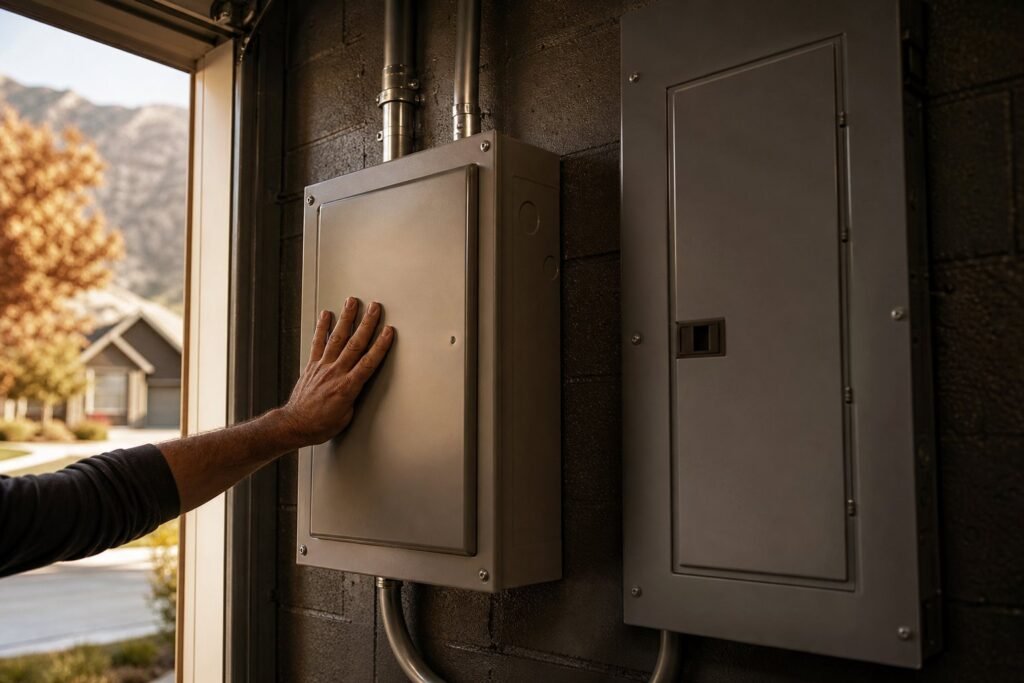
A transfer switch connects your home to exactly one power source at a time, grid or generator, never both. Code requires one for any generator that feeds house wiring because without it, generator power flows backward through the utility transformer and energizes street lines at lethal voltage. Automatic switches do the changeover themselves; manual switches and interlock kits do it legally for far less money. Here is how to choose.
In this guide
What does a transfer switch actually do?
Mechanically, a transfer switch is a gatekeeper between two power sources and one set of house circuits. Its defining feature is not that it switches, any breaker switches, but that it makes the two sources mutually exclusive. The contacts are built so the generator side physically cannot close while the utility side is closed. Your circuits are fed by the grid, or by the generator, and there is no position, no mistake, and no hurried 2 a.m. fumble that connects them to both.
That isolation solves two problems in one motion. It keeps generator power inside your house instead of leaking out to the street, and it keeps utility power off your generator when the grid comes back, which otherwise arrives as a collision that can wreck the machine and worse. Every legal generator connection in the country runs through some version of this device, and every path in our Utah generator guide ends at one.
Why does code require a transfer switch?
Because backfeeding kills line workers. Picture the improvised alternative: a generator plugged into a dryer receptacle with a double-male cord, pushing power into the panel with the main breaker forgotten in the on position. That power exits the house through the meter and reaches the neighborhood transformer, the same device that normally steps voltage down for your home. Fed backward, it steps voltage up, and the “dead” line a repair crew is handling now carries thousands of volts with no warning.
This is why the requirement is not bureaucratic fussiness. The National Electrical Code requires positive isolation between sources for any generator connected to premises wiring, inspectors along the Wasatch Front check for it, and utilities treat backfeeding as the serious offense it is. Beyond the person on the pole, an unisolated connection also endangers your own house: when the grid re-energizes against a running generator, the result is fried windings, tripped or welded breakers, and a genuine fire risk at the panel.
The plain version. A $400 piece of hardware is what stands between your generator and a lineworker’s life. There is no outage, no storm, and no schedule that justifies skipping it.
Automatic vs manual: which transfer switch do you need?
Both types isolate identically; what you are buying with the automatic version is the changeover happening without you. An automatic transfer switch pairs with a standby generator, watches utility voltage, and runs the whole start-transfer-return sequence on its own. A manual switch pairs with a portable, and you are the controller: start the machine, throw the handle, choose the loads.
| Automatic (ATS) | Manual | |
|---|---|---|
| Pairs with | Standby generators | Portable generators via an inlet |
| Who does the changeover | The switch, in seconds, unattended | You, at the panel, in minutes |
| Works when nobody is home | Yes | No |
| Typical installed cost | Bundled into standby projects, commonly $1,000–$3,000 of the total | Commonly $400–$1,500 installed |
| Complexity and service | Control wiring, utility sensing, more to maintain | A handle and contacts; very little to go wrong |
| Best for | Frequent or high-stakes outages, empty houses | Owner-operated backup on a budget |
A useful rule: the switch should match the generator’s personality. An automatic switch on a portable makes no sense, since the machine still needs a human to start it, and a manual switch under a standby throws away the automation you paid five figures for. The machine-side decision is covered in our standby vs portable comparison.
What about interlock kits, the budget-legal option?
An interlock kit is the simplest legal answer of all: a sliding steel plate installed on the face of your existing panel that mechanically prevents the main breaker and a designated generator breaker from being on at the same time. Slide it one way, the house runs on the grid; slide it the other, the generator breaker can close and the main cannot. Same mutual exclusion as a transfer switch, achieved with one moving part.
The appeal is price and flexibility: instead of pre-selecting a handful of circuits into a separate switch cabinet, the interlock gives the generator access to the whole panel, and you manage the load by choosing which breakers to turn on. The catch is that the kit must be listed for your exact panel model, installed with the inlet and a dedicated breaker under permit, and operated with a little discipline, since you decide what runs. On many panels this is the best value in backup power, and it is the heart of the setup an outage-ready portable deserves. Our generator and backup power service installs interlocks, inlets, and the full switch lineup, and will tell you plainly which one your panel supports.
An interlock is a transfer switch distilled to one sliding plate and one honest rule.
How does a transfer switch tie into your panel?
Every option lands at the panel, which makes panel condition part of the conversation. An automatic switch typically installs between the meter and the panel or alongside it, intercepting either the whole service or a protected-loads subpanel. A manual switch cabinet mounts next to the panel and takes over its chosen circuits. An interlock mounts on the panel itself, which means the panel must have the physical space, a compatible listed kit, and bus capacity for the generator breaker.
This is where older Wasatch Front homes hit a fork. A 60s-era panel with a crowded bus, or one of the brands with known failure histories, is a poor foundation to bolt backup power onto, and sometimes the honest sequence is panel first, generator second. Our electrical panel upgrade guide explains how to tell which side of the line your equipment is on, and our panel and meter upgrade service handles the rebuild when it is needed. Done together, a panel upgrade and transfer equipment install share a permit cycle and one utility disconnect, which is meaningfully cheaper than doing them a year apart.
When is the cheap option the right option?
Most of the time, honestly. If your generator is a portable and someone is generally home during storms, an interlock or small manual switch delivers every ounce of the safety and ninety percent of the utility of an automatic system for a fraction of the cost. The whole outage routine with an interlock runs like this:
- Start the generator outside and connect its cord to the wall inlet.
- At the panel, switch off the main breaker, then slide the interlock plate to free the generator breaker.
- Turn the generator breaker on, then bring up your chosen circuits one at a time, largest motor first.
- When the grid returns, reverse the order: circuits off, generator breaker off, plate back, main breaker on.
Two minutes of deliberate steps, and the hardware physically forbids the one combination that could hurt someone. That is the entire case for the manual tier: the safety is identical, and only the convenience is billed separately.
Spend up on automation when the outage pattern or the stakes demand it: houses that sit empty, medical loads, sump pumps guarding finished basements in spring runoff, or owners who simply will not want to walk to the panel in a windstorm, which is a legitimate preference to pay for. What we push back on is the reflexive assumption that automatic means better. The interlock on a healthy panel is not a compromise; it is the correctly sized answer for most of the homes we visit, and the cost guide shows how far apart the tiers really are. For the full context around this hardware, fuels, sizing, and outage planning, start with the complete Utah generator guide.
Quick answers
Is it illegal to backfeed my house through a dryer outlet?
Yes. It violates the National Electrical Code, utility service rules, and it defeats the isolation that protects line crews. It also runs unprotected power through a receptacle circuit never designed as a feeder. If this describes your current setup, unplug it and call an electrician about an inlet and interlock; the legal version costs less than people assume.
Can I add a transfer switch to an existing generator?
Almost always. A portable needs an inlet plus a manual switch or interlock matched to your panel; a standby that somehow lacks an automatic switch needs one sized to its output and service equipment. The work is permitted and inspected, and it is a routine one-day visit in most homes.
Do I need a whole-house transfer switch or just a few circuits?
Match it to the generator. A portable feeding six to ten essential circuits pairs naturally with a small manual switch or an interlock. Whole-service automatic switches belong with standby units sized to carry the load. Oversizing the switch without oversizing the generator buys nothing but cost.
Will a transfer switch work during a brownout?
Automatic switches monitor voltage quality, not just presence, and will transfer when utility power sags badly enough to threaten equipment. Manual setups rely on you noticing. Either way, chronic flicker or dimming with the grid up is a wiring problem, not an outage problem, and deserves troubleshooting on its own.
Who installs transfer switches, an electrician or the generator dealer?
The transfer switch is electrical work at your service equipment: it requires a licensed electrician and a city permit. Dealers often sell hardware and subcontract the wiring. Hiring the electrician directly keeps one company responsible for the panel work, the permit, and the inspection.
Have a generator and no legal way to connect it, or a standby quote you want a second opinion on? We quote the transfer equipment straight, including the inexpensive answer when it fits.
We install transfer switches and interlocks across Weber, Davis, Morgan, Box Elder, and Cache counties. Davis County homeowners can start with our Farmington electrician page for how we handle permits and panel work locally.